




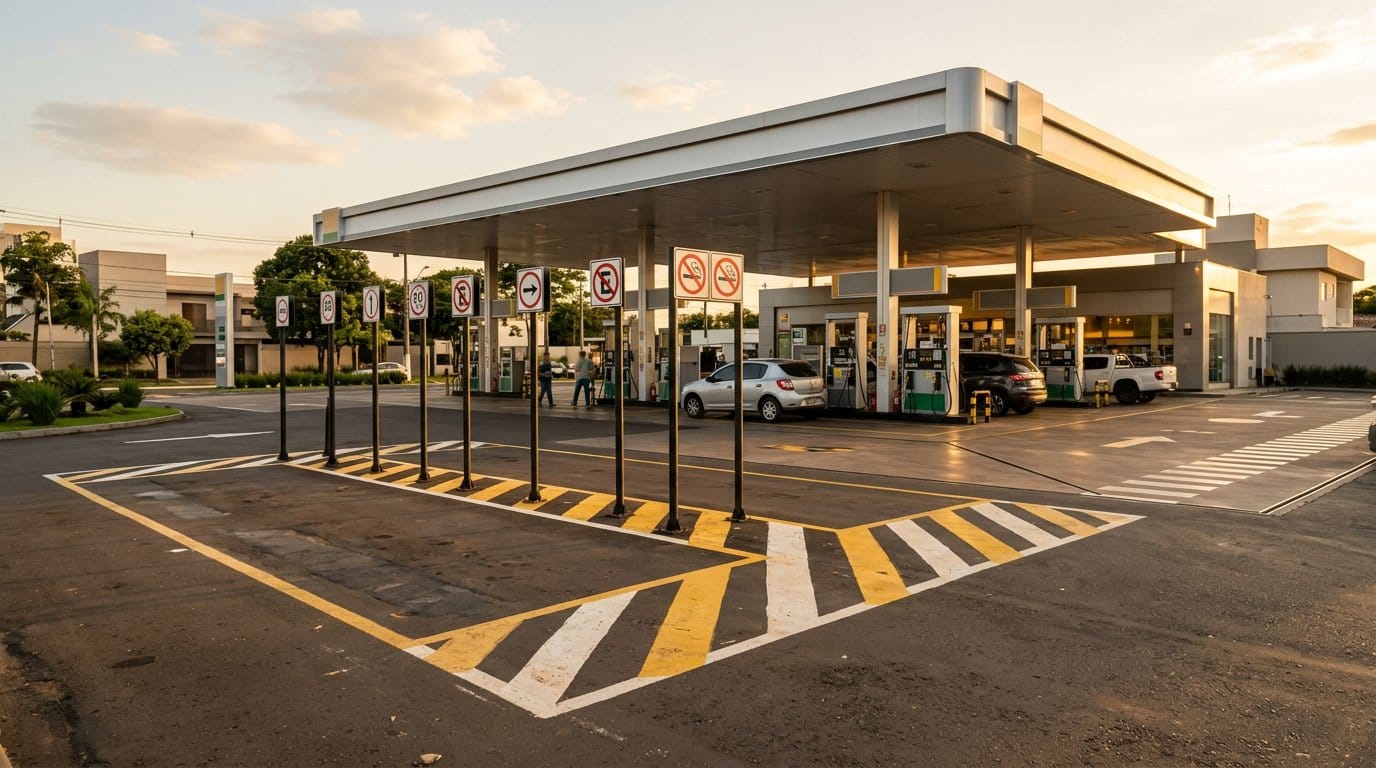
In the United States, the safety rules for flammable liquids at a gas station come from two places: OSHA’s flammable liquids standard, 29 CFR 1910.106, which has a section on service stations, and the model codes your state and city adopt, mainly the International Fire Code (IFC), Chapter 23, NFPA 30A and the National Electrical Code (NFPA 70). For a gas station design, these rules are not optional: they define what can be built, where and how.
What U.S. codes define for the gas station design
The rules affect the design on several fronts at once:
- Classified (hazardous) locations — around dispensers, fill openings, vents and pits, the code marks Division 1 and Division 2 areas, where only suitable electrical equipment can be installed. In OSHA’s Table H-19, the space inside a dispenser enclosure up to 4 ft above its base, and 18 in horizontally, is Division 1; outdoors, the area up to 18 in above grade within 20 ft horizontally of any edge of the enclosure is Division 2. Around an upward vent, Division 1 extends 3 ft from the open end and Division 2 from 3 to 5 ft; around a loose fill connection, Division 2 covers the area up to 18 in above grade within 10 ft. NFPA 30A and NEC Article 514 (Motor Fuel Dispensing Facilities) have their own tables: your engineer uses the edition your AHJ enforces.
- Ventilation — for dispensers indoors, the extent of the classified area depends on the ventilation: Table H-19 uses 20 ft with mechanical ventilation and 25 ft with gravity ventilation. In a lubrication or service room, the area up to 18 in above the floor is Division 2 and any pit is Division 1.
- Electrical installation — all electrical equipment and wiring must be of the type required by, and installed according to, OSHA’s electrical rules (Subpart S), and the NEC adopted in your jurisdiction sets the details. A classified area does not extend beyond an unpierced wall, roof or solid partition, but if a sales room, storage room or restroom has an opening within a Division 1 area, the entire room is classified Division 1 (1910.106(g)(5)).
- Lightning protection — in the U.S., it is designed to NFPA 780 where your AHJ, your insurer or a risk assessment calls for it. Ask early, because it affects the canopy and the store roof.
Minimum distances between dispensers, tanks and buildings
One of the most practical points of these codes for the site layout is the distance that dispensers must keep from lot lines, buildings and ignition sources. In the IFC model text (Section 2303.1), dispensing devices go:
- 10 ft or more from lot lines;
- 10 ft or more from buildings with combustible exterior walls (or noncombustible walls that are not part of a 1-hour fire-resistance-rated assembly) or with combustible overhangs, except canopies built under the International Building Code that shelter the fuel islands;
- where every part of the vehicle being fueled stays on the property;
- where the nozzle, with the hose fully extended, cannot reach within 5 ft of building openings;
- 20 ft or more from fixed sources of ignition.
OSHA adds that there must be no smoking or open flames in fueling areas, and that remote pumps installed above grade outdoors must be at least 10 ft from adjoining property lines and 5 ft from any building opening (1910.106(g)(3) and (g)(8)). In practice, the 20-ft rule and the classified areas decide where a kitchen with open-flame equipment, the store doors, electrical panels and illuminated signs can go. Tank and vent locations follow NFPA 30, NFPA 30A and your state’s tank rules; states and cities adopt different editions and amend them.
Electrical design at a gas station: why it must be specialized
The electrical design of a gas station is far more complex than that of an ordinary building because of the classified areas. The electrical engineer must draw the Division 1 and Division 2 boundaries on the plans according to the NEC edition in force, specify equipment and luminaires suitable for each area and locate the emergency shutoff. In the IFC model text (Section 2303.2), an approved emergency disconnect switch stops the transfer of fuel to the dispensers; for outdoor dispensers it must be readily accessible, within 100 ft of the dispensers but not less than 20 ft from them, and labeled “EMERGENCY FUEL SHUTOFF”. OSHA also requires a clearly identified, easily accessible switch or circuit breaker at a location remote from the dispensers. See our complete gas station design service, where classified areas are marked from the first layout.
What Petrol Group handles in the design
- Dispensers, islands, tanks, fill points and vents laid out with the distances of the code edition your AHJ enforces.
- Classified areas drawn on the site plan before placing the store openings, electrical panels, kitchen and signs.
- Emergency shutoff location coordinated with the cashier’s view of the forecourt.
- 3D renderings, design specifications and drawings for the engineering and permit set.
Petrol Group works remotely. A locally licensed architect or engineer of record signs the project and files it with the authority having jurisdiction (AHJ). More on how we work with U.S. owners: gas station design in the USA.
FAQ
Who signs the hazardous area classification for a gas station?
The electrical engineer of record, licensed in your state, shows the classified areas on the drawings, and the building or fire department (the AHJ) reviews them. Which drawings must be sealed is set by state law.
Do the rules require staff training or only the design?
Both. OSHA’s Hazard Communication standard requires training on hazardous chemicals such as gasoline; EPA’s underground storage tank rules require designated Class A, B and C operators, and Class C operators must be trained before assuming their duties (40 CFR Part 280, Subpart J). Under the IFC, an attended self-service station needs at least one qualified attendant on duty while it is open.
Are the distances the same in every state?
No. States and cities adopt different editions of the IFC, NFPA 30A and the NEC and amend them. That is why we confirm the state and the city before drawing.
Learn about our complete service. See also: tank tightness testing at the gas station.