





Visual Identity for Gas Stations: The Definitive Guide to Attract More Customers, Increase Sales, and Enhance Asset Value
Visual identity for gas stations is a strategic system of visual elements that defines how the station is perceived by customers while directly influencing vehicle flow, conversion rates, average ticket value, and asset appreciation. When integrated with architecture and operations, visual identity goes beyond aesthetics and becomes a real revenue‑generation tool.
In practice, this perception is built through an integrated set of elements such as logo, color palette, typography, architecture, communication, and signage. When these elements are strategically planned and consistently applied, they not only increase brand recognition but also improve customer experience and positively influence purchasing decisions.
Visual Identity Is Not Aesthetics — It Is Revenue
Visual identity for a gas station goes far beyond “making the station look nice.” In reality, it is a strategic sales asset, directly linked to perceived value and competitive positioning.
In a market where the core product — fuel — is essentially the same, brand and visual experience become decisive factors in attracting, retaining, and converting customers.
Outdated visuals, poor signage, or lack of visual standards convey neglect, insecurity, and low perceived value. In contrast, gas stations with a professional, coherent visual identity integrated with architecture and operations communicate organization, credibility, and efficiency — which translates into higher traffic, stronger customer loyalty, and better commercial performance.
In practice, visual identity directly impacts key business indicators such as:
- – Vehicle entry flow
- – Customer dwell time
- – Convenience store conversion rate
- – Average ticket per customer
- – Perception of quality, safety, and trust
- – Real estate and operational valuation
This definitive guide on visual identity for gas stations brings together everything you need to build a strong and competitive brand, integrating branding, architecture, design, logo development, color strategy, visual communication, and commercial strategy — always with a focus on results and long‑term value.
What Visual Identity for Gas Stations Really Means
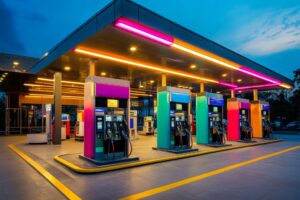
Visual identity is the complete visual system that communicates, clearly and instantly, who the station is, who it serves, and why it should be chosen among similar options.
It is not limited to a logo, but rather the strategic integration of multiple elements that together shape brand perception in daily operations, including:
- – Logo
- – Color palette
- – Typography
- – Graphic elements
- – Architecture and façade
- – Forecourt visual communication
- – Price totems and signage
- – Convenience store design
- – Physical and digital applications
- – 3D visualization and brand standardization
When these elements are disconnected, the station loses strength, consistency, and recognition. When they are aligned, the station becomes a visual reference in its region, even without a traditional fuel brand affiliation.
Visual Identity and Architecture: Where the Brand Takes Physical Form
Architecture is the primary physical expression of a gas station’s visual identity. Elements such as canopy, façade, forecourt layout, circulation, lighting, and volumetry communicate the brand before the first refueling happens.
These architectural details directly influence the driver’s perception while still in motion — meaning every design decision impacts brand value and customer experience.
📌 This topic is part of the complete gas station design strategy, covered in depth in our main guide:
👉 https://petrolgroup.pro/design/
Treating architecture and visual identity as separate disciplines is a serious strategic mistake, often resulting in:
- – Generic, characterless façades
- – Confusing or illegible signage
- – Poor differentiation from competitors
- – Reduced commercial attractiveness
When visual identity and architecture are integrated from the start, the station becomes an active marketing and conversion tool, standing out on the roadway, being easily recognizable from a distance, and associated with trust, organization, and professionalism.
Why Visual Identity Drives Sales
Visual identity directly influences consumer buying behavior — especially in fast, intuitive decisions such as choosing where to refuel. On high‑traffic roads, this decision often happens in less than five seconds, guided primarily by visual perception.
A well‑structured visual identity delivers measurable impacts such as:
- – Increased spontaneous vehicle entry
- – Higher convenience store conversion
- – Greater perceived quality and price acceptance
- – Stronger customer loyalty and recurrence
In this short decision window, visual identity is not just relevant — it is decisive.
Logo Design for Gas Stations: More Than a Symbol
The logo is the core of a gas station’s visual identity. It concentrates meaning, recognition, and brand memory, and must perform efficiently across all customer touchpoints.
A strong logo must work consistently:
- – On price totems
- – On canopies and fascias
- – On fuel pumps
- – Inside convenience stores
- – On digital platforms and social media
- – In printed materials
- – At long distances and high speeds
Effective gas station logos share key characteristics:
- – Simplicity and high legibility
- – Immediate recognition
- – Scalability without loss of clarity
- – Timeless design (not trend‑driven)
- – Adaptability to multiple materials
- – Alignment with brand positioning and target audience
Poorly designed logos compromise the entire visual identity, weaken brand recognition, and reduce commercial efficiency.
Color Strategy: Influencing Purchase Decisions
Color palettes directly shape customer perception and guide rapid purchasing decisions.
Primary color associations:
- – Red → Energy, urgency, action
- – Blue → Trust, safety, stability
- – Green → Sustainability, economy
- – Yellow → High visibility and attention
- – Black → Sophistication and premium positioning
Strategic factors in color selection:
- – Urban or highway context
- – Target audience and positioning
- – Traffic speed and volume
- – Natural and artificial lighting
- – Competitive visual environment
When applied strategically, colors increase visibility and brand recognition. Poor color choices, on the other hand, reduce flow and perceived quality.
3D Visual Identity: Predictability and Efficiency
3D visual identity projects allow investors to visualize the station before construction, turning abstract concepts into realistic, strategic representations.
Benefits include:
- – Realistic visualization of architecture and branding
- – Design adjustments before construction, reducing costs
- – Full brand standardization
- – Seamless integration between architecture and signage
- – Safer, more confident decision‑making
Stations that adopt 3D identity projects experience less rework, higher visual coherence, and more faithful execution.
Creative Gas Station Design (Without Losing Efficiency)
Creativity does not mean excess — it means functional differentiation.
When applied correctly, creative design:
- – Improves circulation and spatial clarity
- – Enhances customer experience
- – Increases dwell time and convenience sales
- – Makes the station stand out in competitive environments
Uncontrolled creativity without technical alignment causes visual noise, confusion, and operational inefficiency. Effective creativity solves problems, guides users, and strengthens the brand.
Forecourt Visual Communication: Where Sales Happen
Signs, decals, totems, and directional graphics are essential components of visual identity in the forecourt. They must:
- – Be instantly legible
- – Guide vehicle and pedestrian flow
- – Enable fast decision‑making
- – Reinforce brand consistency
Well‑planned visual communication improves safety, circulation, and conversion. Poor signage does the opposite.
Visual Identity and Revenue: A Direct Relationship
Stations with professionally planned visual identity show clear performance gains:
- – Higher vehicle throughput
- – Increased average ticket
- – More cross‑sales
- – Lower price sensitivity
Visual identity should be seen not as a cost, but as a long‑term investment that pays for itself through revenue growth, loyalty, and asset appreciation.
When to Renew a Gas Station’s Visual Identity
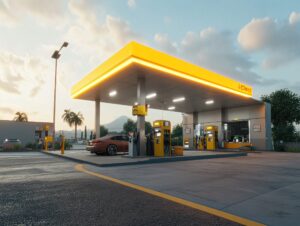
Clear signs include:
- – Outdated visuals
- – Low attractiveness despite good location
- – Visually stronger competitors
- – Change in positioning or target audience
- – Renovation or expansion
- – Revenue stagnation
Renewal is not just cosmetic — it is a strategic repositioning.
Technical Table: Impact of Visual Identity on Performance
| Visual Element | Direct Impact |
|---|---|
| Consistent identity | Brand recognition and trust |
| Façade and canopy | Increased entry flow |
| Forecourt signage | Better circulation and conversion |
| Strategic lighting | Safety and longer stays |
| Visual standardization | Asset appreciation |
Common Visual Identity Mistakes
Improvising without a master project
- – Copying competitors
- – Lack of standardization
- – Ignoring architecture
- – Underinvesting in visibility
- – Short‑term thinking
These mistakes weaken the brand, reduce sales, and devalue the asset.
Visual Identity as a Value Asset
Well‑positioned stations:
- – Are worth more in the market
- – Attract investors and partners
- – Enable expansion and franchising
- – Have higher liquidity
Visual identity is an intangible asset that accumulates value over time.
Specialized Visual Identity Consulting for Gas Stations
Specialized consulting is essential when the goal is to drive sales, positioning, and asset appreciation — not just aesthetics.
Petrol Design integrates:
- – Architecture
- – Engineering
- – Design
- – Visual communication
- – Commercial strategy
🚀 Want to turn your gas station into a visual and commercial reference?
Request a Complete Visual Identity Diagnosis and discover how to elevate performance and asset value.
With Petrol Group, everything your gas station needs is in one place.
A strong visual identity must also be supported by effective visual communication at your gas station — from signage to pump communicators. Combined with smart gas station design, these elements directly influence customer perception and profitability.
Core components of a gas station visual identity
- Logo and brand mark — the foundation of all visual communication
- Color palette — primary and secondary colors applied consistently across all surfaces
- Typography — fonts used in signage, menus, and all printed materials
- Canopy design — the largest and most visible element of your station’s brand
- Totem and price sign — first visual contact from the road
- Pump communicators — brand touchpoint at the moment of purchase
- Uniform design — extends your brand to every customer interaction