





Convenience Store in Gas Stations: The Definitive Guide to Increase Sales and Asset Value
The convenience store in gas stations is now the primary profit center of the business, responsible for the highest operational margins. When properly designed, it increases average ticket size, extends dwell time, strengthens customer recurrence, and enhances asset value. As a result, fueling stops being just a necessity and becomes an experience, while convenience is converted into measurable financial results.
In this context, the convenience store is no longer a simple operational add‑on. Instead, it plays a central role in the profitability of modern gas stations. With fuel margins increasingly compressed, convenience becomes the business unit that sustains results, differentiates the station in the market, and enables more predictable and scalable growth.
For this reason, operators, investors, and fuel groups that understand this dynamic treat the convenience store as a high‑performance strategic asset, not a secondary space. Every decision — from layout to product mix, from visual communication to lighting, and from operations to customer experience — is planned in an integrated way to increase conversion, average ticket, and profitability per square meter.
This definitive guide brings together technical, commercial, and operational criteria consolidated from real Petrol Convenience projects, showing how to transform the convenience store into a structured, predictable, and scalable sales system that enhances the overall value of the gas station.
📌 This content is part of the complete gas station convenience strategy, covered in depth in our main guide:
👉 https://petrolgroup.pro/conveniencia/
The Role of the Convenience Store in Gas Station Financial Performance
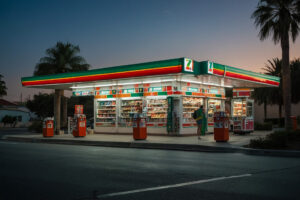
Today, the convenience store concentrates the highest margins and the greatest growth potential within a gas station. Unlike fuel — which is price‑regulated, highly competitive, and margin‑compressed — convenience offers greater strategic flexibility and direct control over results.
Through the convenience store, the station gains:
- – Flexible pricing, allowing fast adjustments based on demand and positioning
- – High product turnover with recurring sales throughout the day
- – Upselling and impulse purchases driven by layout, display, and visual cues
- -Customer loyalty and recurrence, turning occasional visits into habits
In practice, a well‑designed and well‑operated convenience store directly impacts key business indicators:
- – Higher average ticket per customer
- – Longer dwell time on site
- – Increased return frequency
- – Higher total operational profitability
- – Improved asset valuation for investors and networks
Stations that invest strategically in convenience stores are able to offset fuel margin volatility, reduce dependency on fueling volume, and build a more resilient, predictable, and financially sustainable business model.
What an Efficient Convenience Store Really Is (In Practice)
An efficient convenience store goes far beyond aesthetics or product variety. In practice, it is the result of applying commercial engineering to transient retail, where every design and operational decision is oriented toward conversion, speed, and profitability.
Such stores combine, in an integrated way:
- – Customer‑flow‑oriented layout, reducing friction and guiding consumption
- – Clear and objective visual communication that simplifies decisions
- – Sales‑driven lighting that highlights key products and impulse zones
- – A product mix aligned with the real customer profile, prioritizing turnover and margin
- – Simple, fast, and standardized operations for high volume and efficiency
Nothing is random. Every element is designed to stimulate fast decisions, immediate consumption, and qualified impulse purchases — maximizing revenue per customer without compromising experience.
This technical logic, rather than aesthetics alone, is what transforms a convenience store into a high‑performance financial asset within the gas station.
Types of Convenience Stores in Gas Stations
There is no single ideal convenience store model. The most effective format depends on traffic profile, customer behavior, location, and business positioning.
Traditional Convenience Store
Focused on essentials and high turnover:
- – Lean product mix
- – Simple operations
- – Low implementation and management complexity
Ideal for urban and neighborhood stations with predictable demand.
Modern Convenience Store
Focused on experience and higher ticket:
- – Open, fluid, and well‑zoned layout
- – Strategic commercial lighting
- – Clear, decision‑oriented visual communication
Encourages longer dwell time and improved value perception.
Compact Convenience Store
Designed for small stations or limited areas:
- – Extreme space optimization
- – Reduced but highly strategic assortment
- – Strong focus on turnover and margin
When well planned, it delivers excellent profitability per square meter.
Premium Convenience Store
Value‑added, brand‑driven positioning:
- – Enhanced sensory experience
- – Premium products and food service
- – Strong visual identity integrated with the station
Suitable for premium locations, highways, and higher‑income audiences.
Choosing the right model must be a technical decision. When aligned with real conditions, the convenience store becomes a true engine of profitability and asset appreciation.
Convenience Store Design: What Really Matters
An effective convenience store project is not based on trends alone. It considers technical factors that directly impact sales and profitability:
- – Highly visible and inviting entrance
- – Fluid and intuitive circulation
- – Strategically positioned gondolas for impulse buying
- – Well‑located checkout to capture last‑minute purchases
Clear zoning of beverages, snacks, food service, and essentials accelerates decisions and improves conversion.
Poorly planned projects result in:
- – Low conversion rates
- – Invisible daily sales losses
- – Confusing customer experience
- – Inefficient use of space
A structured project turns the store into an intelligent sales environment, where every square meter works in favor of financial performance.
Convenience Store Lighting
Lighting is one of the strongest sales triggers in convenience retail. When properly designed, it influences:
- – Perception of cleanliness, organization, and quality
- – Highlighting of strategic products
- – Customer dwell time
- – Sense of safety and comfort
High‑performance stores use:
- – Uniform general lighting
- – Accent lighting for key categories
- – Warm lighting in food service areas
Poor lighting reduces conversion. A professional lighting design transforms the store into a powerful sales inducer.
Product Mix: What to Sell in a Convenience Store
Product mix directly affects profitability and must be defined by customer profile, peak hours, and location.
High‑performance categories include:
- – Cold beverages
- – Snacks and impulse foods
- – Basic automotive products
- – Personal convenience and emergency items
- Coffee and food service (when viable)
More SKUs do not mean more profit. Excess variety increases complexity and reduces efficiency. Deciding what not to sell is as important as choosing what to sell.
In‑Store Visual Communication
Internal visual communication is a strategic sales tool. Its role is to:
- – Highlight high‑margin categories
- – Simplify navigation and decision‑making
- – Stimulate impulse buying
- – Reinforce organization and professionalism
Poor communication causes confusion, lower conversion, and silent sales losses. In efficient stores, visual communication works together with layout, lighting, and mix to maximize performance.
Ideal Process to Build or Renovate a Convenience Store

- 1- Traffic and customer analysis
- 2- Positioning definition (economic, modern, premium, hybrid)
- 3- Architectural and commercial project
- 4- Sales‑oriented lighting and ambiance
- 5- Simulation and validation
- 6- Standardized execution
Following this process, the convenience store becomes a true sales, loyalty, and asset‑value engine.
Technical Table: Convenience Store Impact
| Element | Direct Business Impact |
|---|---|
| Efficient layout | Higher average ticket |
| Strategic lighting | Longer dwell time |
| Correct product mix | Higher turnover and margin |
| Visual communication | More impulse purchases |
| Standardization | Asset value appreciation |
Common Mistakes in Gas Station Convenience Stores
- – Improvisation without a project
- – Copying models without customer analysis
- – Excess low‑turnover products
- – Inadequate lighting
- – Confusing layout
Each of these mistakes costs sales daily and limits profitability.
Frequently Asked Questions
Is a convenience store really profitable?
Yes. When well planned and operated, it becomes the main margin driver and financial stabilizer of the station.
Is it worth investing in a small store?
Absolutely. Compact stores can be extremely profitable per square meter when strategically designed.
Can I renovate without closing the station?
Yes. With proper planning and phased execution, operations can continue without revenue loss.
Convenience Store Consulting
At Petrol Convenience, we design convenience stores focused on performance and results, not trends.
Our projects consider:
- – Real traffic and consumer behavior
- – Customer profile and product mix
- – Sales‑oriented layout
- – Strategic lighting
- – Efficient visual communication
- – Asset valuation
The objective is clear: more sales, higher margins, and greater asset value.
🚀 Turn your convenience store into a true profit machine.
Request a Technical Convenience Store Diagnosis and discover how to increase ticket, turnover, and asset value with method, strategy, and predictability.
With Petrol Group, everything your gas station needs is in one place.
A great convenience store project goes beyond the blueprint — it requires thoughtful store decoration to create an inviting atmosphere, and smart space planning to optimize every square meter of your convenience store for maximum sales.