




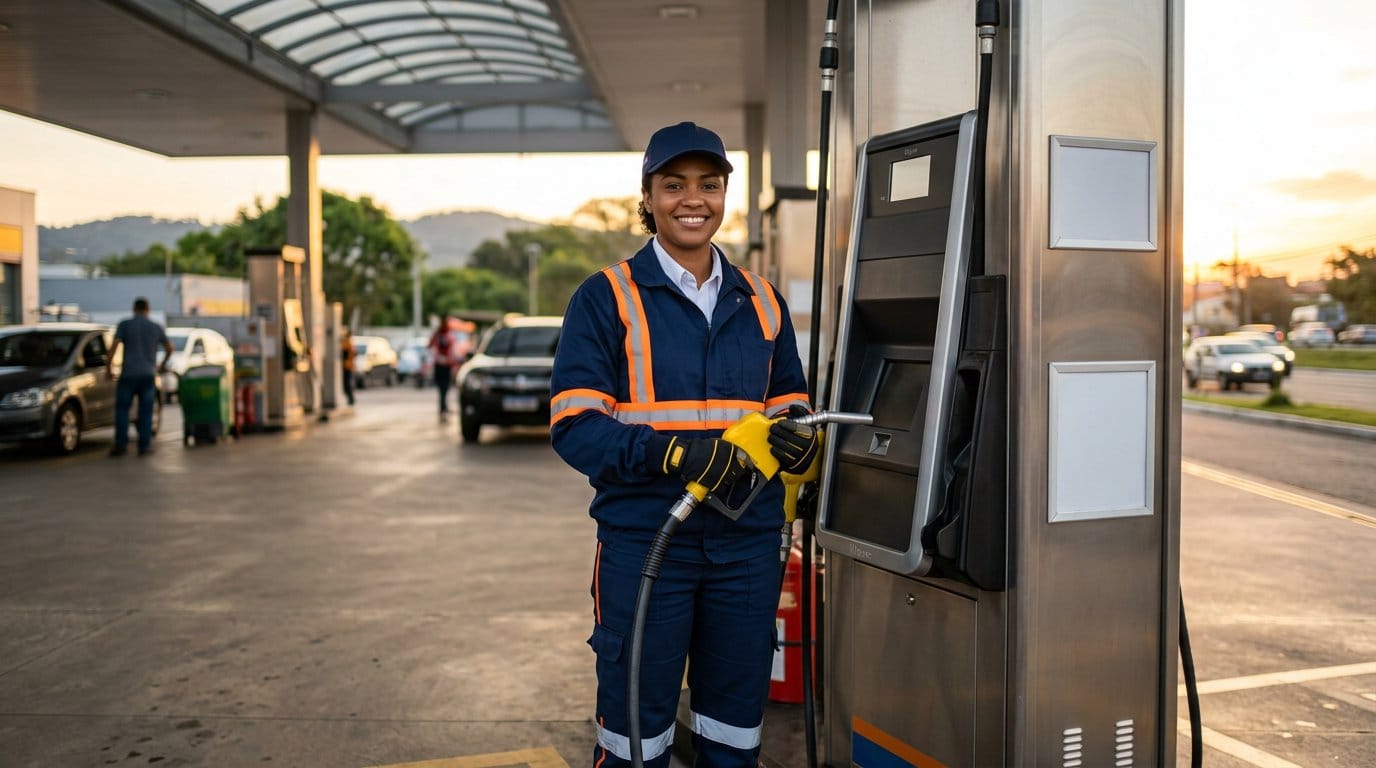
A gas station attendant’s uniform is not just about looks — it is a safety issue. In the U.S., OSHA requires employers to assess workplace hazards and provide the right protective equipment, and using the wrong material in an area with flammable vapors can lead to a serious accident. Petrol Group designs attendant uniforms that combine safety and brand identity.
What U.S. rules require for attendant uniforms
There is no federal standard that prescribes the fabric of a gas station attendant’s uniform. What OSHA does require is that the employer assess the workplace for hazards and select protective equipment that matches them (29 CFR 1910.132); protective footwear, when needed, must comply with the consensus standards the rule references, such as ASTM F2413 (29 CFR 1910.136). States that run an OSHA-approved State Plan enforce rules that must be at least as effective as the federal ones. For workers in hazardous (classified) areas — the forecourt and the tank area — good practice is: clothing that does not build up electrostatic charge, no fabrics made of pure synthetic fibers that hold static, safety footwear with a static-dissipative sole, and no metal accessories that could cause sparks.
The right fabrics for the uniform
Recommended fabrics: 100% cotton (does not build up static, but is less durable), cotton/polyester blends with a certified antistatic treatment, or FR (flame-resistant) fabric for roles that handle hoses. Fabrics to avoid: pure polyester, pure nylon, untreated viscose — all of them build up static charge and can cause a spark in an area with flammable vapors.
How to combine safety and brand identity
A uniform can be technical and still match the station’s brand. Petrol Group designs uniforms that follow these safety criteria and carry the station’s colors and logo — with embroidery or heat-set screen printing (never plastisol on areas highly exposed to heat).
PPE beyond the uniform
Depending on the hazard assessment, the usual items are: nitrile gloves for chemical resistance to fuels (hand protection, 29 CFR 1910.138), safety glasses for handling chemicals (eye protection, 29 CFR 1910.133), and safety footwear with a protective toe cap and a static-dissipative sole.
FAQ
Do inspectors check attendant uniforms?
In the U.S., there is no federal uniform specification for attendants, but OSHA — or your state’s OSHA-approved plan — can cite an employer that has not assessed hazards or provided the required protective equipment. Check any additional state or local requirements with your authority having jurisdiction (AHJ).
See: gas station uniforms, managing attendants and gas station regulatory compliance.