




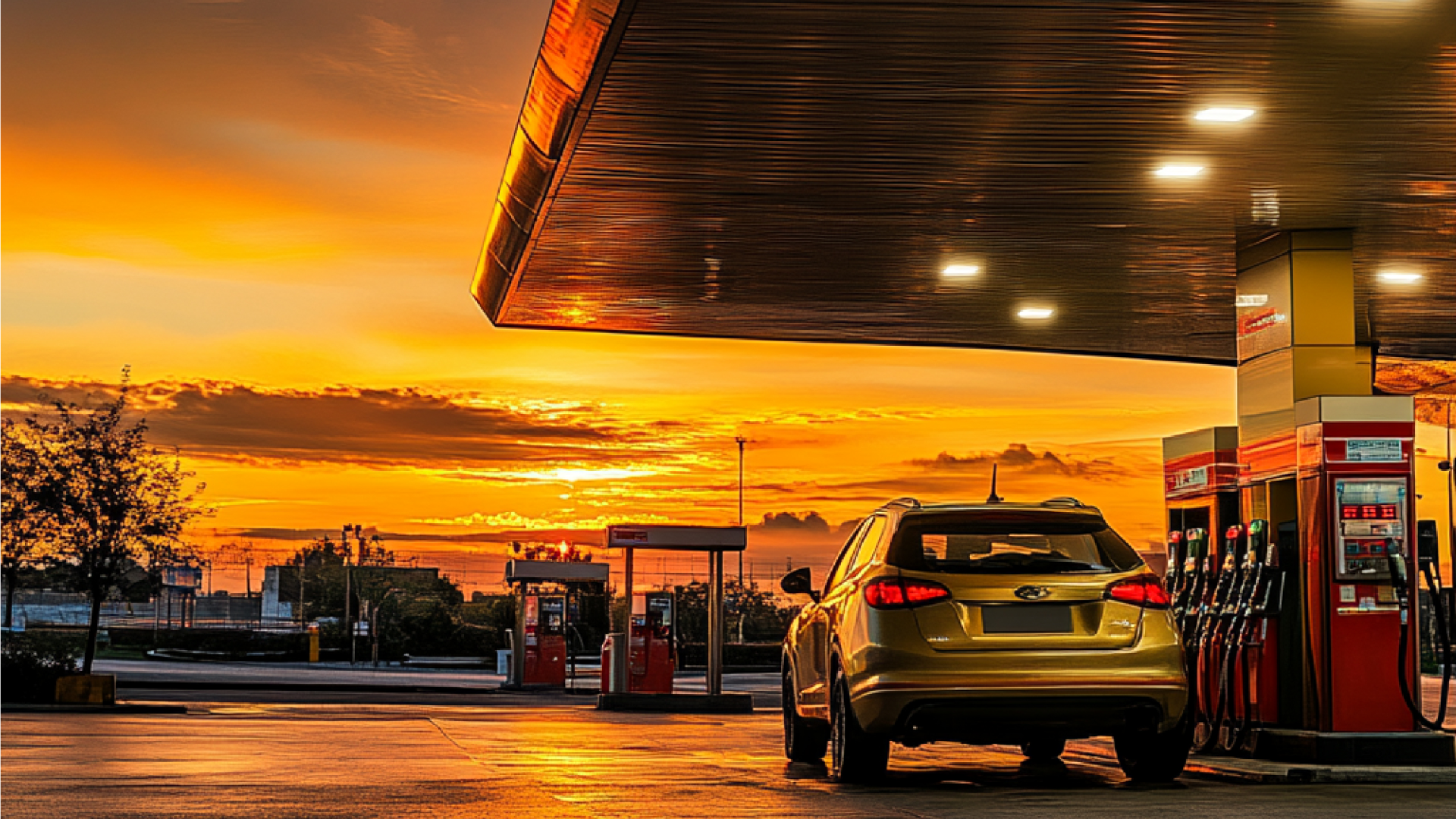
Gas station brand identity is not just a matter of looks. In fact, it is a strategic tool that shapes perception, positioning and commercial performance.
In the fuel industry, where customers decide in seconds where to fill up, especially on high-traffic roads, a station’s image can determine whether the choice goes to your business or, on the other hand, to the competitor next door.
Investing in brand identity, therefore, is not just about modernizing the facade. More than that, it means increasing traffic, strengthening trust and, as a result, reducing your dependence on price alone.
Why does brand identity directly affect sales?
Unlike other industries, a gas station operates in a fast-decision environment. Customers, often in their car and on the move, visually assess:
- – Organization
- – Lighting
- – Clarity of communication
- – Appearance of the pumps
- – Condition of the canopy and facade
If the environment conveys safety and professionalism, the choice happens almost automatically, because customers associate organization with reliability. On the other hand, when there are signs of disorder or visual clutter, price sensitivity rises and the perceived value of the service drops.
That way, brand identity stops being just aesthetic communication and becomes a competitive strategy that directly influences perception, decision-making and profitability.
What really changes in the customer’s perception
Facade and canopy as a point of attraction
The canopy fascia is the main element of recognition from a distance. That is why well-applied colors, correct proportions and proper lighting not only increase visibility but also reinforce the brand’s positioning in the market.
In addition, a standardized facade conveys stability and credibility, which are decisive factors at the moment of choice. As a result, the station stands out from the competition and establishes itself as a reference in the area.
Standardized signage
Pylon signs, panels, banners and wayfinding signs must follow the same graphic standard. When they do not, and the elements are inconsistent, the station looks disorganized and loses professionalism.
On the other hand, when there is visual consistency across all communication, customers perceive structure, standardization and attention to detail. As a result, trust grows and the decision to fuel up becomes faster and more natural.
Organization of the pumps and fueling area
Clean pumps with properly applied graphics and clear information increase the sense of safety and professionalism. They also reinforce the station’s credibility at the decisive moment of purchase.
As a result, customers feel more comfortable fueling up and, thanks to that positive experience, tend to come back and become loyal to the station.
Strategic lighting
Well-lit stations sell more at night. That is because, besides increasing the visibility of the brand and the pumps, lighting reinforces the perception of protection, organization and care for the customer.
That way, a proper lighting design is not just an aesthetic feature but a commercial strategy that directly affects vehicle traffic and, as a result, revenue.
Integration with the convenience store
The brand identity needs to be integrated between the forecourt and the store. When that integration is missing and the look is disconnected, the brand loses strength and consistency in the customer’s eyes.
In contrast, when there is visual continuity between the spaces, the station positions itself as a structured, professional business. As a result, perceived value rises and, with it, the potential for a higher average ticket.
How brand identity increases margin
Competing on price alone reduces profitability. However, when a station works on perceived value, it expands its capacity to retain customers and build loyalty.
The sequence is clear:
- – Strategic brand identity
- – Greater perception of safety
- – Increased traffic
- – Better experience
- – Higher average ticket
- – Higher operating margin.
So brand identity acts directly on the financial structure of the business.
Mistakes that quietly reduce sales
Even well-located stations can lose revenue because of visual flaws, such as:
- – Too many promotional banners
- – A mix of colors with no strategy
- – A poorly applied logo
- – A poorly maintained facade
- – Insufficient lighting
- – Improvised communication
These factors lower perceived value and fuel the price war over every cent per gallon.
When it is time to modernize your brand identity
A strategic review of the brand identity makes sense when:
- – The station has lost competitiveness
- – Sales volume has dropped
- – The brand looks outdated
- – You plan to reposition
- – The goal is to increase margin without depending only on price
In these scenarios, modernizing is not a cost, it is strategic repositioning.
Brand identity is an investment, not an expense
A visually strategic station does not compete on price alone. It competes on preference.
When well planned, gas station brand identity:
- – Strengthens the brand
- – Builds trust
- – Expands traffic
- – Raises the average ticket
- – Sustains consistent growth
More than aesthetics, it is about commercial positioning.
Talk to a specialist in architecture and brand identity for gas stations
Petrol Group integrates architecture, communication and strategy with a commercial focus to turn perception into concrete results.
If you want to reposition your station and, at the same time, increase its sales potential, talk to our team and find out how to build a strategic brand identity that is consistent with your market and, above all, profitable.
With Petrol Group, you get everything for your gas station in one place!
Learn more: