




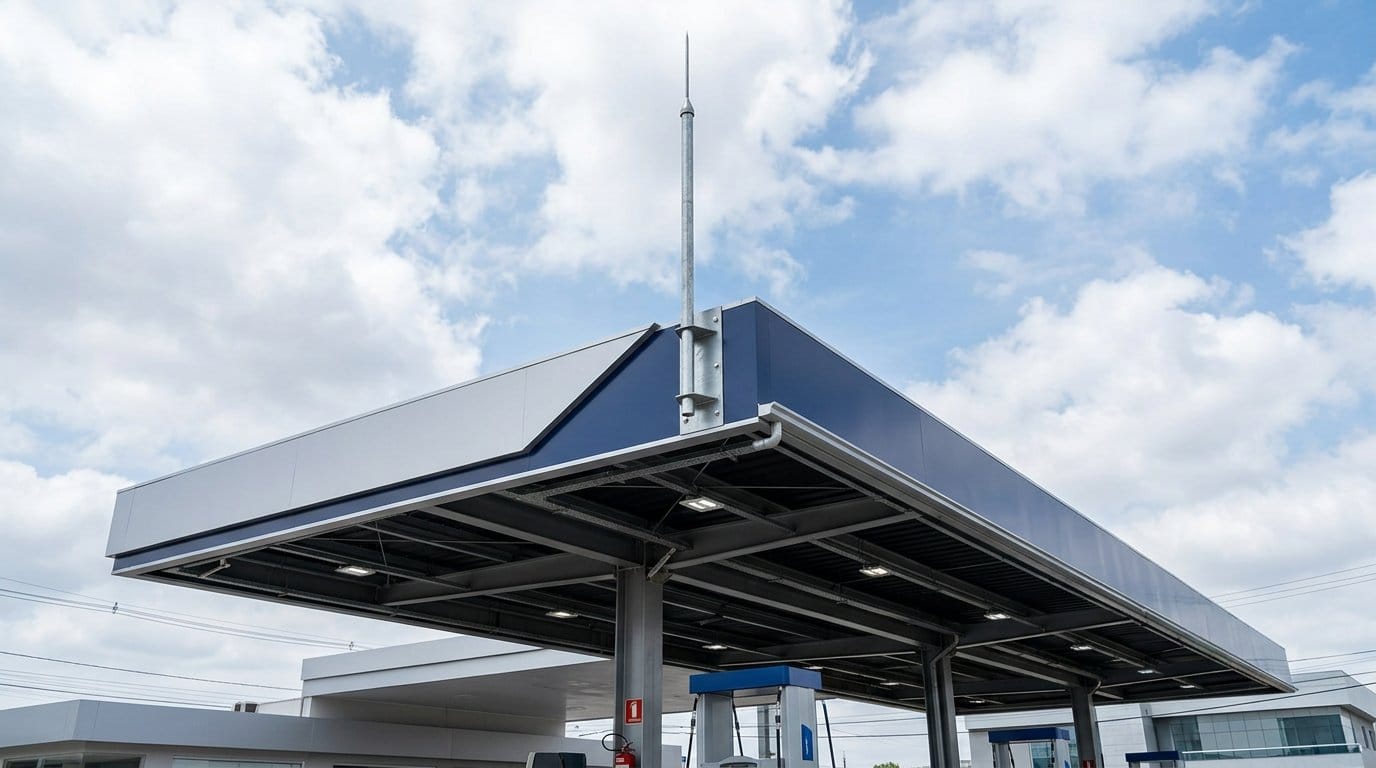
Lightning protection at a gas station is a critical safety measure, even where no code mandates it: a strike on an unprotected forecourt can be catastrophic. The good news: planned together with the rest of the project, it is straightforward to design and reasonably priced.
Why gas stations are especially sensitive to lightning
Three features raise the risk: (1) the canopy is a large metal structure, often the tallest on the site; (2) fuel vapors around dispensers, vents and fill points can be ignited by a strike; (3) vent risers, conduit and metal piping link the tanks, the dispensers and the building, creating paths for lightning current. That is why NFPA 780 includes structures containing flammable vapors or liquids in its scope. A good system protects all of these points.
Applicable standards in the U.S.: NFPA 780 and the codes
NFPA 780 sets the requirements for design, installation and maintenance. As NFPA explains, components must be listed or labeled, installers need skills accepted by the authority having jurisdiction (AHJ) and periodic inspections follow the AHJ. An annex guides the risk assessment that shows whether protection is needed. A typical system has air terminals on the canopy and the building, conductors, grounding electrodes, bonding of metal parts and surge protective devices (SPDs).
The 2024 International Building Code (Section 2703) says that, where provided, a system must follow NFPA 780 or UL 96A (UL 96A may not be used for buildings that handle or store flammable liquids or gases) and must come with SPDs. The National Electrical Code (NFPA 70) requires bonding the lightning ground terminals to the building’s grounding electrode system (250.106), and forecourt wiring follows Article 514. Whether you must have a system depends on your state and local codes, your AHJ, your insurer and your brand: confirm it early.
What drives the cost of lightning protection at a station
There is no reliable U.S. average, so price the actual project. Cost depends on canopy size and number of structures (canopy, store, car wash), soil conditions for grounding, SPDs, and new construction versus retrofit. An electrical engineer licensed in your state seals the design; most station projects include it in the electrical design, which is when it costs least.
What Petrol Group handles in the design
We design the architecture and brand identity and coordinate them with the engineer of record: air terminals that fit the canopy fascia and the pylon sign, down conductors hidden in the column cladding, all shown in the 3D renderings and construction documents. A locally licensed engineer signs the lightning protection design and files it with your AHJ.
FAQ
Is lightning protection required at a gas station in the U.S.?
Not by one nationwide rule. Where a system is provided, the 2024 IBC points to NFPA 780. Whether you need one depends on your local codes, AHJ, insurer and brand.
Does lightning protection also protect against surges?
The system handles the direct strike. Surges on power and data lines need SPDs, which the 2024 IBC requires wherever a lightning protection system is installed.
How often should the system be inspected?
At intervals set by the AHJ, as NFPA 780 requires, and after any strike or canopy work such as a reimage.
Learn about our complete gas station design.