





Gas station signage: The Definitive Guide
Gas station signage is the strategic system of elements — such as lighting, signage, LED panels, and wayfinding — designed to attract drivers in motion, increase entry rates, boost sales, and enhance the station’s value as a commercial asset. When properly planned, signage transforms visibility into revenue.
In gas stations, customer decisions happen in seconds. Even before considering price, brand affiliation, or the convenience store, signage determines whether the station is noticed, understood, or simply ignored within the traffic flow.
In a market where the core product is essentially the same, those who communicate better sell more. For this reason, signage stops being a decorative feature and becomes a direct conversion tool. It influences vehicle flow, entry rate, average ticket, dwell time, and — most importantly — the perception of quality and trust.
This definitive guide to gas station signage is based on real projects, traffic analysis, consumer behavior, and commercial performance indicators applied to fuel retail. The objective is clear and measurable: to transform the station’s visual system into an active engine for sales, competitive differentiation, and asset appreciation.
📌 This content is part of the complete gas station visual strategy, covered in depth in our main guide:
👉 https://petrolgroup.pro/en/visual/
What Signage Means in Gas Stations (In Practice)
Signage in gas stations is not just about what is visible, but how the station communicates with drivers in motion, within seconds, at different distances and speeds.
In practice, it brings together all elements that attract, guide, inform, and convert customers before a conscious decision to stop is made.
Signage includes, in an integrated way:
- – Brand identity applied to architecture for immediate brand recognition
- – Signage and logos scaled for real‑world traffic reading
- – Technical and accent lighting for visibility, safety, and nighttime presence
- – Informational and promotional panels, including pricing and services
- – Functional and commercial wayfinding to organize flow and behavior
- – Integration between forecourt, facade, and convenience store, creating a seamless experience
In high‑performance stations, these elements do not work independently. They form a strategic visual system, designed to maximize visibility, increase entry rates, enhance customer experience, and strengthen the perceived value of the station as a business.
Direct Impact of Signage on Station Performance
A well‑planned signage system directly impacts key performance indicators, influencing the entire journey — from attraction to conversion and asset valuation.
In practice, the main effects include:
- – Increased spontaneous vehicle flow through long‑distance visibility
- – Higher forecourt entry rates, reducing reliance on price alone
- – Improved perception of price and quality in competitive markets
- – Greater convenience store conversion and dwell time
- – Higher real estate value and asset appreciation
- – Increased attractiveness to investors, operators, and fuel brands
Stations with organized, well‑lit visuals aligned with brand positioning consistently outperform competitors — even when prices are similar. Customers don’t buy fuel alone; they buy perceived safety, trust, and experience.
Technical Elements of Gas station signage
Lighting for Gas Stations
Lighting is one of the most underestimated — and most decisive — elements of signage. When properly designed, it does far more than illuminate; it guides, enhances, and converts.
Strategically, lighting is responsible for:
- – Long‑distance visibility, especially at night and on high‑speed roads
- – Increased sense of safety, a critical factor in stop decisions
- – Enhancement of architectural volumes and brand identity
- – Direction of circulation and functional areas
High‑performance projects typically include:
- – Architectural LED lighting for facades, columns, and canopies
- – Functional forecourt lighting for operational safety
- – Accent lighting to create visual hierarchy
- – Strategic lighting in the convenience store to drive sales
LED Panels for Gas Stations
LED panels significantly expand communication capacity by allowing dynamic, real‑time messaging with high visual impact.
In practice, they are used for:
- – Dynamic promotions and limited‑time offers
- – Seasonal and institutional campaigns
- – Promotion of services and convenience features
- – High‑impact nighttime communication on fast roads
Key strategic benefits include:
- – Excellent long‑distance visibility
- – Instant message and price updates without operational friction
- – Higher driver attention and increased entry probability
Signage and Logos
Signage is the primary brand recognition element and often the driver’s first visual contact with the station.
For effective performance, signage must meet clear technical criteria:
- – Legibility in motion, considering distance, speed, and viewing angle
- – Simple, clean, scalable typography
- – High color contrast for day and night visibility
- – Full integration with architecture and lighting
Common signage mistakes include:
- – Excessive information in a single element
- – Decorative or illegible fonts
- – Lack of visual standardization
- – Visual competition between signage, pricing, lighting, and panels
Convenience Store Signage
The convenience store holds the highest profit margin within the station. Therefore, its signage must be treated as a sales tool, not decoration.
An effective store visual system:
- – Encourages entry even when fueling was the original intent
- – Organizes categories for fast comprehension
- – Stimulates quick purchase decisions
- – Increases average ticket through strategic product emphasis
Lighting, colors, internal signage, promotions, and storefront design must work together to maximize conversion.
Ideal Process to Define Signage
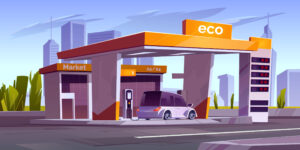
High‑performance signage results from a structured, technical process, not isolated decisions.
1. Traffic and Visibility Analysis
Understanding real‑world conditions:
- – Road speed (defines reading time and scale)
- – Approach angles (signage and panel positioning)
- – Reading distance (typography, contrast, hierarchy)
Without this, visuals may look good but perform poorly.
2. Brand Positioning Definition
The visual system must clearly express:
- – Target audience
- – Station profile (economy, premium, urban, highway, hybrid)
- – Brand tone aligned with commercial strategy
Misalignment reduces trust.
3. Architecture + Brand identity Integration
Identity is integrated into architecture, not applied on top:
- – Visual continuity between facade, forecourt, and store
- – Consistent materials, colors, volumes, and lighting
- – Elimination of visual conflicts
This integration transforms elements into a system.
4. Lighting Design (Lighting Engineering)
Lighting is treated as a strategic asset, balancing:
- – Energy efficiency
- – Long‑distance visibility
- – Visual comfort
5. Dynamic Communication
Beyond fixed elements, stations must communicate in real time using:
- – LED panels
- – Functional and commercial signage
- – Campaign‑aligned messages
6. 3D Simulation and Validation
Before execution:
- – Day and night simulations
- – Readability and contrast validation
- – Technical adjustments
This step protects investment and ensures predictability.
Technical Table: Signage Impact
| Visual Element | Direct Business Impact |
|---|---|
| Architectural lighting | Increased nighttime traffic |
| Legible signage | More spontaneous entries |
| LED panels | Higher attention and conversion |
| Store visuals | Higher average ticket |
| Visual standardization | Brand and asset appreciation |
Common Signage Mistakes
Many stations lose sales not due to price or location, but because of basic signage errors:
- – Improvisation without technical design
- – Copying competitors without context analysis
- – Underinvesting in lighting
- – Visual overload that confuses drivers
- – Lack of coherence between forecourt, facade, and store
These are strategic errors, not aesthetic ones. They silently reduce visibility, conversions, and revenue every day.
Frequently Asked Questions
Does signage really influence sales?
Yes. It directly affects entry decisions, trust perception, and purchase behavior — both at the pump and in the convenience store.
Is signage worth it without changing fuel brand?
Absolutely. Independent stations often outperform branded ones when their signage is strategic and professional.
Do LED panels work for any gas station?
Only when integrated into traffic flow, positioning, scale, content, and overall visual strategy. Isolated panels lose effectiveness.
Specialized Signage Consulting for Gas Stations
Gas station signage requires visual engineering, commercial strategy, and integrated architecture. Without this alignment, visuals become cost instead of assets.
Petrol Visual develops performance‑driven signage systems focused on:
- – Attraction (visibility and entry rate)
- – Conversion (fueling and convenience sales)
- – Asset appreciation (brand and valuation)
Each project is built on traffic analysis, positioning, architecture, lighting, and consumer behavior — ensuring measurable results and investment protection.
🚀 Want to turn your station’s signage into a true sales machine?
Request a Technical Signage Diagnosis for Gas Stations and discover how to increase flow, revenue, and asset value in a structured, professional, and safe way.
With Petrol Group, everything your gas station needs is in one place.
Effective signage starts with a well-defined brand identity for your gas station. For practical guidance on implementing it across your forecourt, also explore how LED panels for gas stations can amplify your brand visibility day and night.
Key signage elements for gas stations
- Brand pylon sign — visible from 200+ meters, communicates your identity before customers enter
- Pump toppers — advertising panels on dispensers that increase convenience store sales
- Canopy branding — the largest visual surface of your station, seen from all directions
- Facade panels — ACM or illuminated panels that define your station’s personality
- Interior signage — guides customers inside the convenience store and increases impulse purchases
- Uniforms — your team’s appearance is part of your signage system