




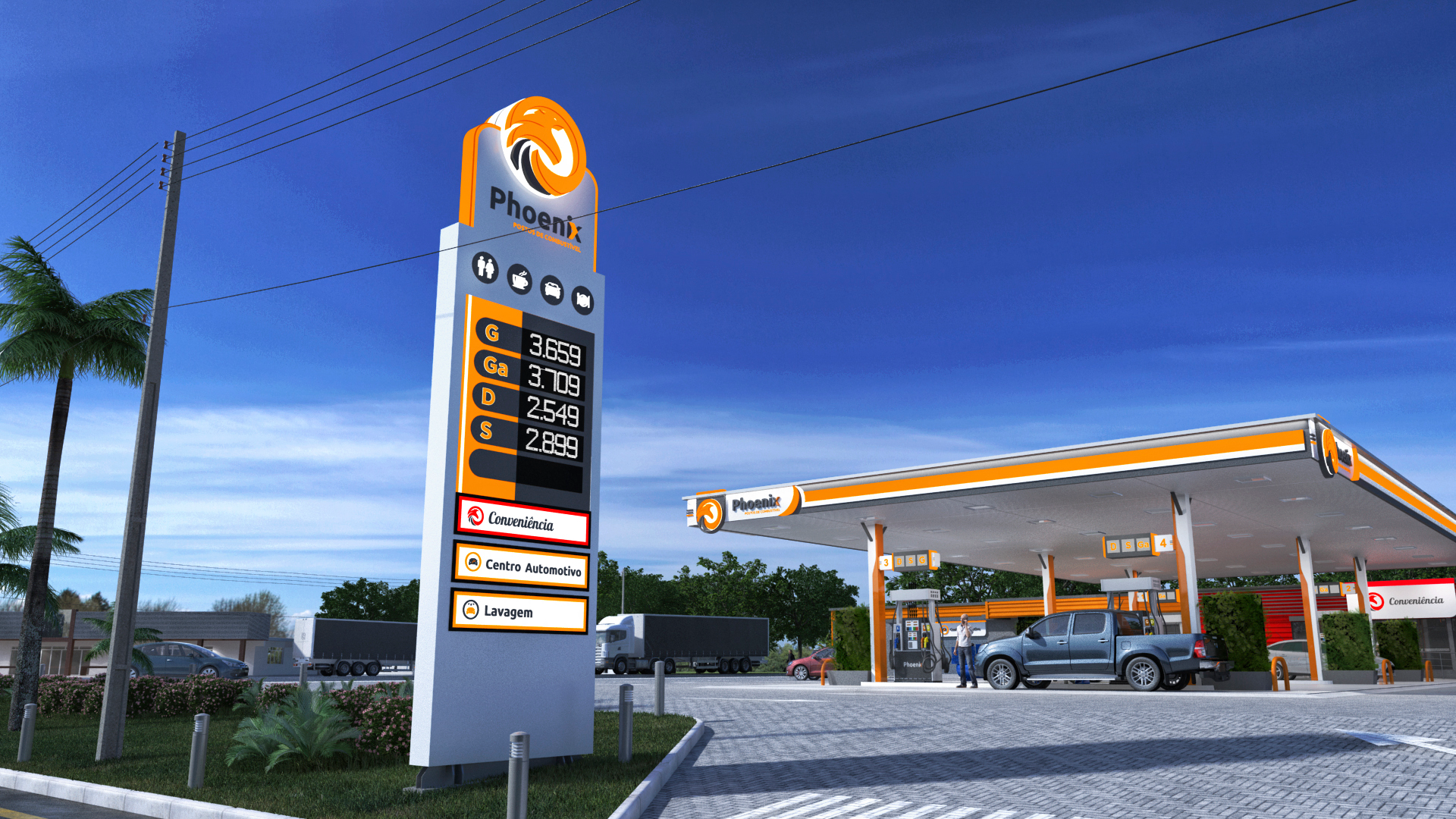
A gas station pylon sign is the tall freestanding sign at the entrance that carries the station’s brand and fuel prices. In the United States, two layers of rules shape it: your local zoning and sign code decides how tall, how big and how bright it can be and where it can stand, while state law decides what the price display must show. California, for example, requires price numerals at least 6 inches high, including all taxes, visible from every street next to the station.
This guide covers state price-sign rules with their citations, how local sign codes limit pylon signs, sign types and materials, height and visibility, LED lighting limits, structure and electrical listing, maintenance and the sign’s role in your brand, with examples from Petrol Group projects.
What a pylon sign has to do
Drivers decide whether to pull in while they are still on the road, in a few seconds. The pylon sign answers their three questions from a distance: which station is this, what does a gallon cost and where is the driveway. That is why it stands next to the entrance, perpendicular to traffic, and is usually double-faced to serve both directions.
Price matters most in that decision. According to NACS (June 2026), price is still the number-one factor in where drivers buy gas, while one in 10 motorists names fuel brand as the top reason. The competition is wide: NACS counts nearly 152,000 convenience stores in the U.S., more than 120,000 of them selling fuel, and they account for an estimated 80% of the fuel sold at about 148,000 fueling outlets (NACS, “Convenience Stores Sell the Most Gas”).
Common types
| Type | What it is | Best fit |
|---|---|---|
| Pylon sign with LED price changers | Brand cabinet on top, LED digits updated from a phone or computer | Stations that change prices often or sell several grades |
| Pylon sign with manual price panels | Backlit cabinet with numerals changed by hand | Smaller sites with infrequent price changes |
| Monument sign | Low sign on a solid base, close to grade | Districts that cap height or ban pole signs |
| Stand-alone price sign | Prices only, next to the supplier’s standard sign | Branded sites that want their own name or promotions on the street |
| Pylon with a full-color LED message center | Screen for images and promotions in addition to prices | Sites with a c-store, car wash or food service to promote |
Petrol Group’s gas station pylon and price sign service describes these models, single- or double-sided, including mega pylon signs up to 82 ft (25 m) tall.
State price-sign rules: what the numbers must show
There is no single federal price-sign rule for gasoline. States set it, usually through their weights and measures or business codes. Three examples with very different approaches:
| State | Citation | What the sign must do |
|---|---|---|
| California | Bus. & Prof. Code 13531 | Every station must post a sign with the total prices of the three major grades, clearly visible from the adjacent street or highway, and from each street at an intersection |
| California | Bus. & Prof. Code 13532 | Total price per gallon including all taxes, in numerals at least 6 inches high and of uniform size and color; brand and the word “gasoline” at least one-third the size of the price numerals; grade at least one-sixth |
| Florida | Fla. Stat. 526.111 (2026) | No duty to post prices, but any sign that does must show tax included, and fraction numerals at least half the size of the largest whole number |
| Minnesota | Minn. Stat. 239.751, subd. 3 | Price per gallon including all taxes and fees, in figures of uniform size; any condition, such as “cash price”, clearly stated on the sign |
Cash and credit pricing deserves its own line on the sign. In California, if the same grade sells at different prices, the sign must show each of the higher prices in numerals of equal size and explain the conditions in letters at least one-third the size of the price (13532(c)). A discount sign must show the full price it is taken from (13532(b)). Violating 13531 is an infraction with a fine of up to $500, and a misdemeanor after two prior convictions.
Many states base their method-of-sale rules on NIST Handbook 130 (2026 edition). Its street-sign guideline says price signs should show complete dollar-and-cents numerals, clearly legible and full size. If you plan to add EV charging to the pylon, section 2.33.4 asks for the price per kWh in whole cents or tenths of a cent; for hydrogen, section 2.31.4 asks for the price per kilogram in whole cents plus the service pressure (H35 or H70). Check which edition your state has adopted with your state weights and measures office.
Local zoning and sign codes: height, area, setback
Federal law mostly stays out of on-premise signs. The Highway Beautification Act controls billboards along Interstate and federal-aid primary highways, but it exempts signs “advertising activities conducted on the property on which they are located”, including signs changed electronically (23 U.S.C. 131(c)(3)). Your pylon sign is an on-premise sign, so the city or county sign code is the rule that counts.
Those codes can treat on-premise and off-premise signs differently. In City of Austin v. Reagan National Advertising (2022), the Supreme Court held that an on-/off-premises distinction is facially content neutral under the First Amendment. A typical sign code regulates:
- maximum height of freestanding signs, and whether pole (pylon) signs are allowed at all or only monument signs;
- maximum sign area per face and per street frontage;
- setback from the property line and from driveways, so the sign does not block sight lines;
- number of freestanding signs per frontage;
- illumination and electronic message centers (brightness, hold time, animation);
- sign permit and, often, engineered drawings.
State price-sign laws and local codes interact. California lets a city or county exempt areas designated as scenic corridors or historic preservation areas from the price-sign requirement (13531(b)). Before you order a sign, get the code section for your parcel’s zoning district from the planning department and confirm whether fuel price panels count toward the allowed sign area.
Materials: steel structure, ACM and LED
Most pylon signs follow the same recipe: a galvanized steel frame anchored to a concrete foundation, clad in aluminum composite material (ACM), with LED price modules or backlit panels and the logo in acrylic or channel letters.
- Steel structure: galvanized columns and framing resist corrosion; a steel base plate bolts to anchor bolts cast into the footing. Petrol ships the steel foundation base for the concrete pour, and the sign arrives sealed, with internal ventilation, according to the service page.
- ACM cladding: two thin aluminum skins bonded to a polymer core. In one reference product, Alucobond Plus, panels are 3 or 4 mm (about 1/8 or 5/32 in) thick with 0.5 mm (about 0.02 in) aluminum skins and a mineral-filled core rated B-s1, d0 for fire under the European standard. It bends and routes cleanly and holds brand colors.
- Price display: LED digits or manual panels (compared below).
| Factor | LED price changer | Manual backlit panels |
|---|---|---|
| Price change | From a phone or computer, over wi-fi or bluetooth | An employee swaps numerals at the sign |
| Night reading | Digits emit their own light | Depends on the cabinet’s internal lighting |
| Upfront cost | Higher (modules, controller, power supply) | Lower |
| Cost per change | Close to zero | Labor plus a ladder or lift on tall signs |
To decide, multiply the number of price changes per month by the cost of each manual change and compare it with the price gap between the two systems. The more often prices move and the taller the sign, the faster LED pays back.
Height and visibility
The right height keeps the sign readable above cars, trees, walls and your own canopy, early enough for a driver to read it and slow down. A quick way to size it: multiply speed in mph by 1.47 to get feet per second.
| Road speed | Feet per second | Time to read a sign first seen at 500 ft |
|---|---|---|
| 25 mph | 37 ft/s | about 13.5 s |
| 35 mph | 51 ft/s | about 9.7 s |
| 45 mph | 66 ft/s | about 7.6 s |
| 65 mph | 95 ft/s | about 5.2 s |
Faster roads need the sign to be seen from farther away, with larger numerals. In California the 6-inch minimum is a floor, not a target. Before fixing the height, drive the road in both directions, note where the sign must first appear and list what blocks the view.
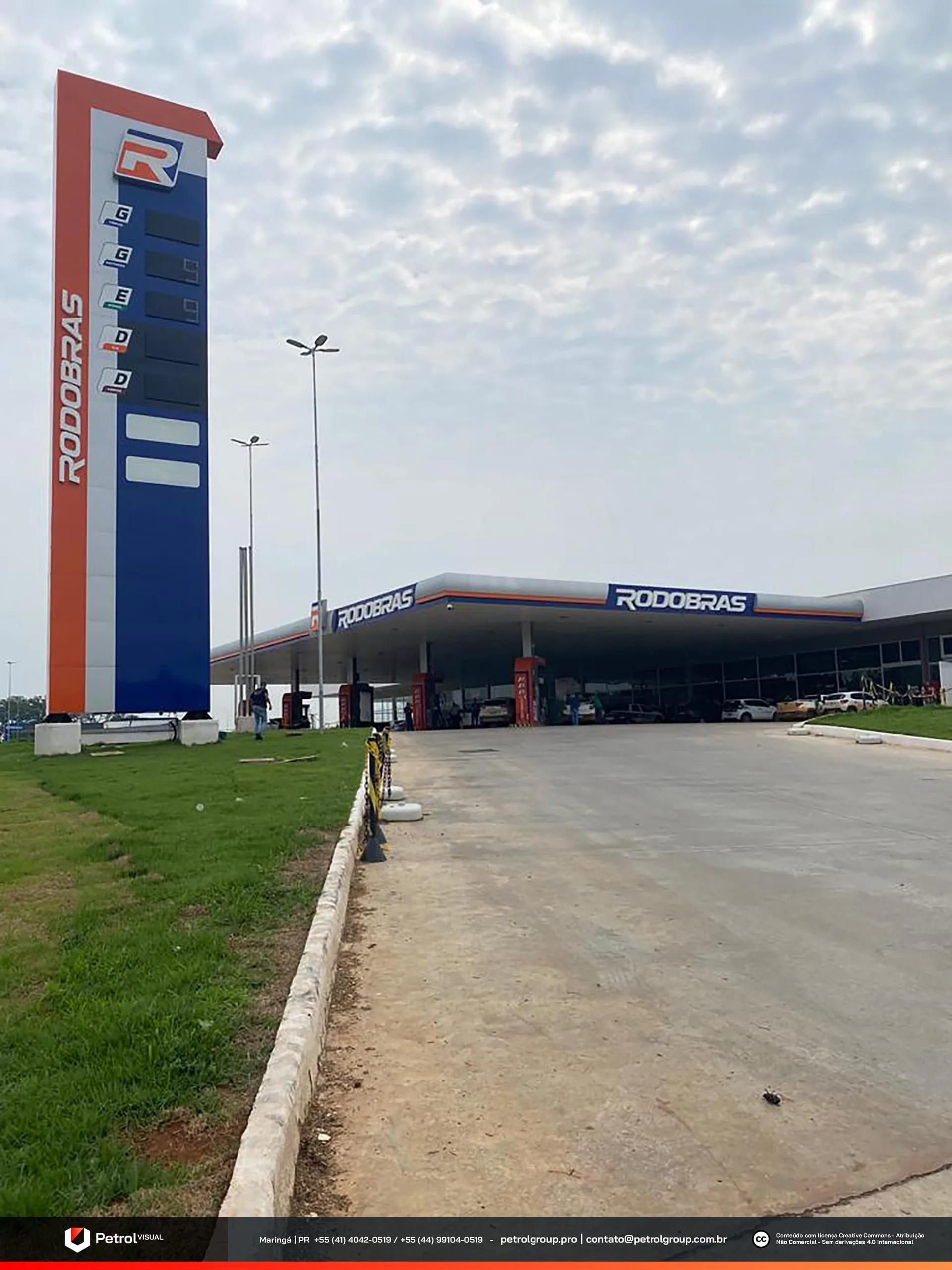
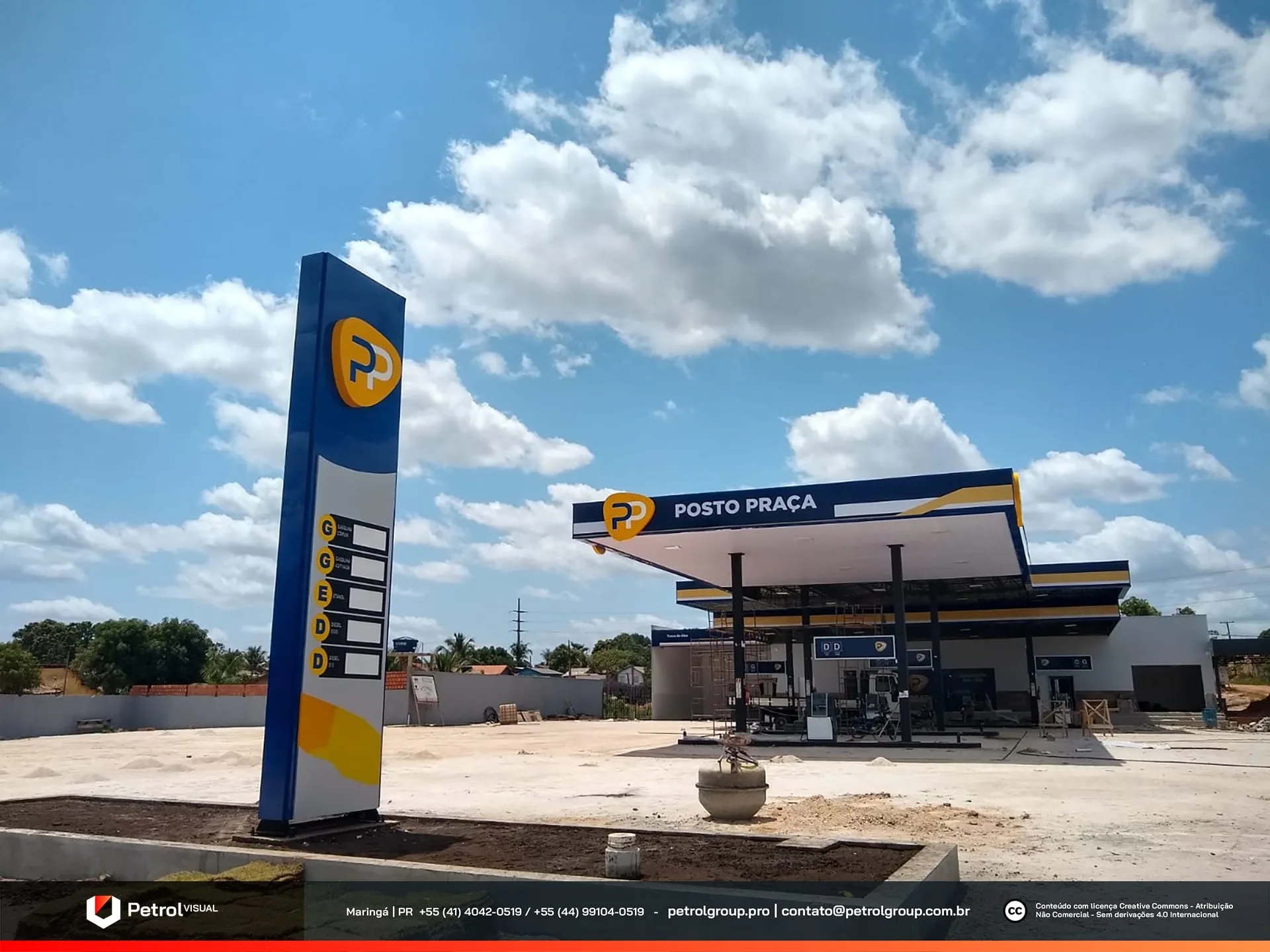
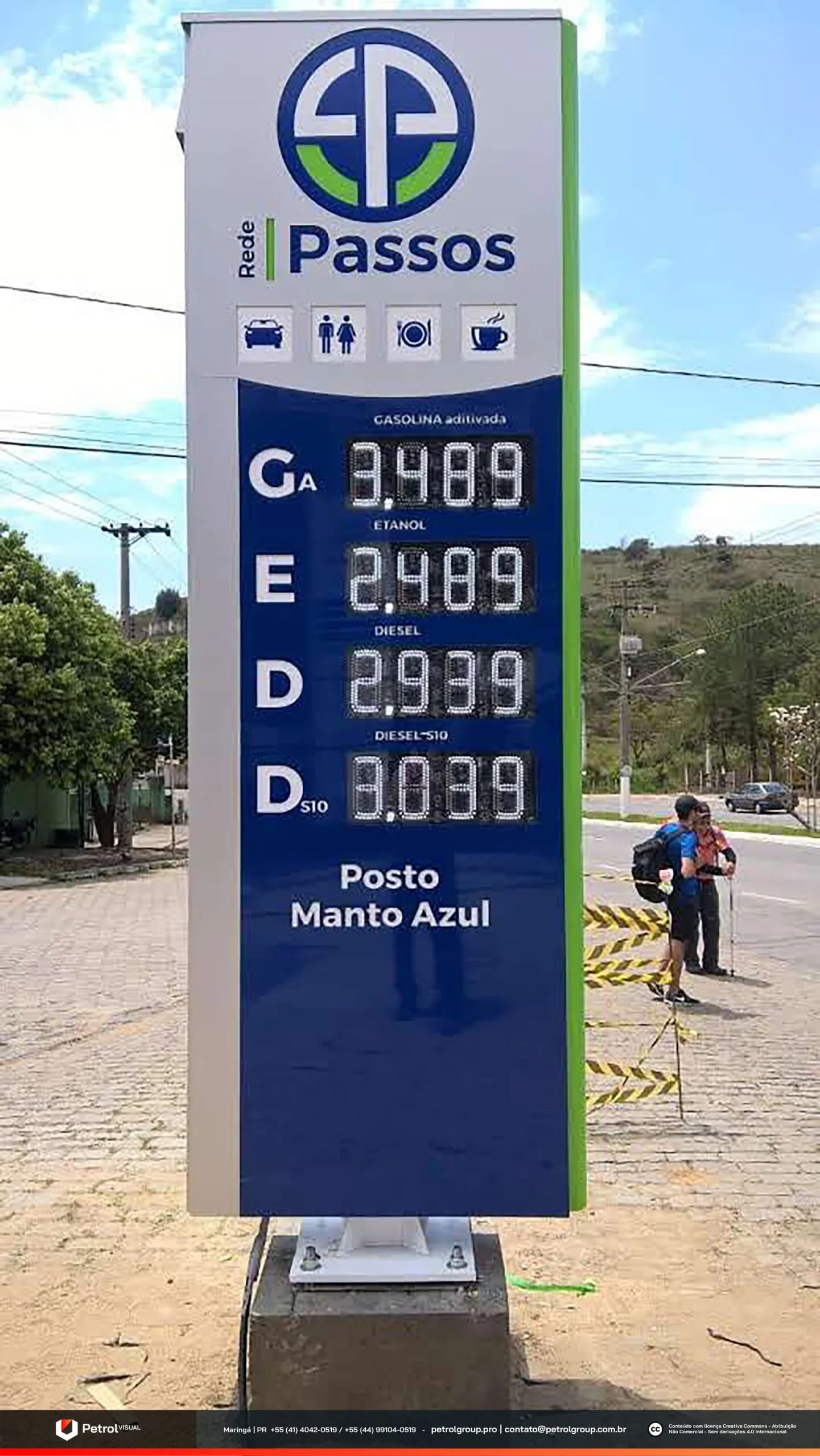
On Petrol projects in Brazil, height follows the site. The Passos station in Aparecida, São Paulo, has a price sign over 4 m (about 13 ft) tall in ACM with LED price panels. At the Praça station in Jacundá, Pará, the owner asked for a large sign to draw new customers, and the pylon rose above 5 m (about 16 ft) with an acrylic logo on top. At Rodobras in Nova Mutum, Mato Grosso, the pylon is over 10 m (about 33 ft) tall, clad in blue, white and orange ACM with large LED price panels.
Legibility checklist
- Price numerals the same size and color for every grade, with strong contrast to the background.
- Brand at the top, where it is seen first and from farthest away.
- Double-faced when traffic comes from both directions.
- Few messages: drivers read for a few seconds.
- Base set back from the curb and out of the sight line of drivers leaving the lot.
Lighting and LED brightness limits
Many sign codes cap the brightness of electronic message centers (EMCs). The most common benchmark comes from the International Sign Association (updated August 2016): EMCs should not exceed 0.3 footcandles over ambient light at night, measured at a distance that depends on sign area. The ISA formula is the square root of the sign area in square feet times 100, so a 100 sq ft display is measured from 100 ft and a 50 sq ft display from about 71 ft. ISA’s model language also calls for a light sensor or other device that dims the display automatically.
Codes may also limit animation, scrolling and how often an EMC message can change. LED price digits usually fall under the same section, so ask your sign maker for a photocell dimmer and a controller that can be set to your code’s limits.
At the Ebenezer station in Centenário do Sul, Paraná, Petrol added LED panels to the blue and yellow ACM price sign so prices read day and night. For display options, see LED displays for gas stations.
Structure, electrical listing and permits
A pylon sign is a large panel on a post: wind pushes the panel and tries to overturn the whole assembly. It must be engineered for the design wind speed in the building code your jurisdiction has adopted, usually the IBC with wind loads from ASCE 7, and many permit offices require drawings sealed by a licensed engineer showing the foundation, anchor bolts and steel sizes.
Electric signs are covered by UL 48, Electric Signs (edition 15, last revised May 14, 2025), and their installation by Article 600 of the National Electrical Code, NFPA 70. Inspectors usually look for a listing label on the sign and a disconnect for the sign circuit. Keep the sign and its wiring out of the classified (hazardous) areas around dispensers and tank fills unless the equipment is rated for them; your electrical engineer will map those zones.
For a wider look at the codes that apply to the whole site, see gas station codes and standards.
Maintenance
- At every price change: check from the road, in both directions, that every digit lit up and that the sign matches the dispensers.
- Weekly: look at the sign after dark for dead modules, letters or faces.
- After high winds or storms: look for loose ACM panels, shifted faces, water inside the cabinet and any movement at the base.
- Once a year, with a technician: anchor bolts and fasteners (tightness and rust), steel coating, gaskets, internal ventilation, power supplies, controller and grounding.
- Cleaning: water and mild detergent on ACM and acrylic; no solvents or abrasives.
- When rules change: state or local amendments can force a retrofit, so keep the controller and cabinet layout flexible.
The pylon sign’s role in your brand
The pylon is the only piece of your brand a driver sees before deciding to turn in. The canopy fascia, dispensers and store come into view later. It has to match the rest of the site: same colors, same logo, same lettering.
- Branded station: the pylon follows the supplier’s image standards; your own name usually goes on a price sign or a secondary sign.
- Independent (unbranded) station: the pylon is the main carrier of your own brand. See brand identity for independent gas stations.
- Multi-site operators: the pylon is what makes every location recognizable as the same chain.
Two portfolio examples. For Auto Posto ABC, in Minas Gerais, Brazil, the red, yellow and black ACM sign was designed to standardize the look of the chain’s 8 locations. At Lyra in Barreiros, Pernambuco, a station with only two dispensers, a large manual-change price sign was the first step of the project, so a small site could stand out.
A note on Brazil, where these photos come from
In Brazil the federal fuel regulator sets the price-display rule nationwide. ANP Resolution 948/2023 requires cash prices for every fuel on a price sign at the entrance, easy to see from a distance day and night (art. 20), with prices per liter in two decimal places (art. 22) since April 10, 2024. The Passos sign below, in a photo published in 2023, still shows three decimals.
From design to installation
- Site survey: frontage, driveways, road speed, obstructions and overhead power lines.
- Code check: height, area, setback, illumination and permit rules for your zoning district; state price-sign rules.
- Content: grades, cash and credit prices, brand and services.
- Design and 3D: proportions, colors, faces and a photo simulation on site.
- Engineering: wind design, foundation and electrical, sealed if required.
- Permit, fabrication and installation: footing, cure time, setting the sign, wiring and inspection.
- Final check: read it day and night from both directions and match it against the dispensers.
Cost depends on height, number of faces, LED or manual pricing, foundation size, shipping distance and site access. Ask for bids on the same specification so you compare like with like.
Frequently asked questions
Do gas stations have to post prices on a street sign?
It depends on the state. California requires a sign with the total prices of the three major grades, visible from each adjacent street (Bus. & Prof. Code 13531). Florida does not require posting, but regulates any price sign you do display (Fla. Stat. 526.111).
How tall can a gas station pylon sign be?
Your local sign code sets the limit, and it varies widely; some districts allow only low monument signs. Federal highway rules exempt on-premise signs, so check the code for your zoning district before you order.
How big do the price numbers have to be?
California requires price numerals at least 6 inches high, of uniform size and color, including all taxes. Other states set no minimum height but require uniform size, tax-included prices or minimum fraction sizes, as Minnesota and Florida do.
Do I have to show both cash and credit prices?
Where a state regulates it, yes. In California, when the same grade sells at different prices, the sign must show each higher price in numerals of equal size and explain the conditions. Minnesota requires conditions such as “cash price” to be stated on the sign.
How bright can an LED price sign be?
Many codes follow the International Sign Association recommendation of no more than 0.3 footcandles above ambient light at night, measured at a distance based on sign area, with automatic dimming. Check your local code, which may be stricter.
Does a pylon sign need a building permit and an engineer?
Almost always a sign permit, and often engineered drawings for wind loads and the foundation under the adopted building code. The sign should be listed to UL 48 and wired under NEC Article 600.
Can I add EV charging prices to my pylon sign?
Yes. NIST Handbook 130 (2026) asks for the price per kWh in whole cents or tenths of a cent on street signs, plus clear terms when more than one rate applies in a session. Confirm your state’s adopted version.
Petrol Group has worked only with gas stations for 29 years, with more than 983 projects in 16 countries, from sign design to construction drawings. To plan a new sign or a reimage, see our pylon and price sign service, our consulting, more work in the portfolio, or contact our team.