





A gas station convenience store’s product list fits into 14 categories: cold beverages, ice and charcoal, beer and wine, coffee and dispensed drinks, prepared food, salty snacks, candy, frozen treats, tobacco, grocery fill-ins, health and beauty, automotive, seasonal items and services. How much space each one gets depends on its job: some bring customers in every day (traffic), some pay the bills (margin) and some make drivers pick your forecourt over the one across the street (draw). Several categories need a license or carry federal rules, and the mix shifts a lot between an interstate exit and a neighborhood corner.
This guide gives you the list by category with the role of each one, the NACS numbers that explain why c-store mixes look the way they do, the rules for alcohol, tobacco, vapes, food, OTC medicine and SNAP, how to lay out gondolas and coolers, and how to adjust the mix for highway and urban sites.
List of products for convenience stores by category
In the table, traffic means items that sell every day and bring people in; margin means items that leave the most gross profit per dollar sold; draw means items that make customers stop or come back even if they are not the top sellers.
| Category | What to stock | Main role | Watch out for |
|---|---|---|---|
| Packaged cold beverages | Bottled water, soda, energy drinks, sports drinks, ready-to-drink tea and coffee, juice | Traffic and draw | The destination of the store: full cooler doors, always cold |
| Ice and charcoal | Bagged ice, charcoal, lighter fluid, foil pans | Weekend traffic | An empty ice merchandiser on a Saturday costs real money |
| Beer and wine | Domestic and craft beer, single cans, wine where allowed | Traffic and margin | State license, 21+ only, local hour limits |
| Coffee and dispensed drinks | Brewed coffee, cappuccino, fountain soda, frozen drinks | Margin and draw | Health permit and equipment cleaning |
| Prepared food | Roller grill, pizza, breakfast sandwiches, wraps, salads | Margin and draw | Hot and cold holding temperatures |
| Salty snacks and alternative snacks | Chips, nuts, jerky, seeds, crackers | Traffic and impulse | Center gondolas, top flavors at eye level |
| Candy and gum | Chocolate, mints, gum, packaged sweets | Impulse and margin | Belongs at the checkout |
| Frozen treats | Ice cream bars, single pints | Seasonal margin | Chest freezer near the exit or the coffee bar |
| Tobacco and nicotine | Cigarettes, cigars, nicotine pouches, lighters | Traffic, with thin cigarette margins | Behind the counter, 21+, FDA-authorized vapes only |
| Grocery fill-ins | Milk, bread, eggs, coffee, sugar, toilet paper, batteries | Draw (solves the emergency) | Needed if you want to accept SNAP |
| Health and beauty, OTC | Pain relievers, allergy pills, toothbrushes, feminine care, sunscreen, bandages | Margin and service | Pseudoephedrine products go behind the counter |
| Automotive | Motor oil, additives, washer fluid, wiper blades, fuses, bulbs | Margin and trust | Keep it near the door that faces the pumps |
| Seasonal and local | Halloween candy, holiday cookies, summer coolers, local snacks | Draw | Its own endcap, changed every season |
| Services | ATM, lottery, prepaid cards, bill pay | Draw and traffic | Zero shelf space, extra trips |
Bundles tie the categories together: coffee and a breakfast sandwich in the morning, a drink and a snack on the road, ice, charcoal and beer on Saturday. A bundle lifts the average ticket without needing more customers, as long as the items sit close to each other on the floor.
Traffic, margin and draw: what the NACS numbers show
NACS, the convenience retailing trade association, has published State of the Industry data every year since 1970. Its 2025 figures, released in April 2026, explain most of the logic behind a good mix (NACS, April 2026):
- The store out-earns the pumps. Fuel was 65.0% of sales dollars but only 38.8% of gross profit dollars. The store, with about 35% of sales, brought in the other 61.2% of gross profit.
- Food is the margin engine. Foodservice made up 28.5% of in-store sales and 38.9% of in-store gross profit in 2025, up from 11.9% of in-store sales in 2005. Prepared food was 73.9% of foodservice sales.
- Packaged beverages are No. 2, at 18.7% of in-store sales. In-store sales reached a record $341.2 billion, up 1.7%.
- Tobacco brings traffic, not profit. Cigarettes fell from 30.9% of inside sales in 2015 to 18.8% in 2024, with an average margin of 13.76%. Other tobacco products grew to 7.6% of sales with a 29.50% margin (NACS, March 2026).
For the owner, the takeaway is simple: cold drinks and cigarettes walk people to the register; coffee and food pay for the square footage. A store that only sells packaged goods still makes sales, but it leaves its best-margin category on the table.
How to measure the role of each item in your store
Your own POS data beats any industry average. Four calculations settle most mix decisions:
- Gross margin (%): (retail price − cost) ÷ retail price.
- Inventory turns: cost of goods sold for the period ÷ average inventory at cost.
- GMROI: gross margin dollars for the period ÷ average inventory at cost. It shows whether a pricey, slow item is worth its shelf.
- Sales per linear foot: category sales ÷ linear feet of shelf it uses. Categories that sell little per foot give space to categories that sell a lot.
Then run an ABC ranking: sort items from highest to lowest sales. The few items at the top can never be out of stock; the tail that neither turns nor earns margin gets cut to free space.
Store size and number of SKUs
NACS defines a convenience store as a quick-trip retailer that is typically under 5,000 sq ft, keeps extended hours and offers at least 500 SKUs, with beverages, snacks, candy and tobacco in the mix. It describes six formats (NACS, “What Is a Convenience Store?”):
| Format | Size | What it sells |
|---|---|---|
| Kiosk | Under 800 sq ft | Tobacco, beverages, snacks, candy; in-store is about 10% of revenue |
| Mini | 800 to 1,200 sq ft | Fuel-first, minimal grocery, pre-packaged sandwiches |
| Limited selection | 1,500 to 2,200 sq ft | Broader mix, foodservice limited to a roller grill |
| Traditional | About 2,500 sq ft | Dairy, bakery, snacks, beverages, tobacco, grocery, food to go |
| Expanded | 2,800 to 3,600 sq ft | More grocery shelving or a real foodservice program with seating |
| Hyper | 4,000 to 5,000 sq ft | Departments such as bakery, restaurant area or pharmacy |
Use the table as a size yardstick, not a shopping list. In a small store, start with what turns and solves a problem: cold drinks and ice, snacks and candy, coffee, emergency health and beauty, tobacco. Charcoal, automotive and seasonal items come in as local demand proves them. For build-out budgets by format, see our guide to convenience store design cost in the USA.
What needs a license or has special rules
Check the rules for each category before you buy inventory. Federal rules apply everywhere; states, counties and cities add licensing, hours and taxes on top.
| Product | Rule | Source |
|---|---|---|
| Beer and wine | 21+ purchase age; state retail license and local hours | 23 U.S.C. §158; state alcohol beverage control agency |
| Cigarettes and smokeless | 21+; photo ID for anyone under 30; face-to-face sale only; no single cigarettes | 21 CFR 1140.14 and 1140.16 |
| E-cigarettes | Only FDA-authorized products may be sold | FDA Center for Tobacco Products |
| Prepared food | Local health permit; hot holding at 135°F or above, cold holding at 41°F or below | FDA Food Code 2026, §3-501.16, as adopted locally |
| Pseudoephedrine cold medicine | Behind the counter, photo ID, logbook, daily limit | Combat Methamphetamine Epidemic Act (DEA) |
| SNAP acceptance | Minimum staple food stock or more than 50% of sales in staple foods | 7 CFR 278.1 |
| Shelving and counters | Accessible routes and counter heights | 2010 ADA Standards |
Beer and wine
Federal law withholds highway funds from any state that allows people under 21 to buy alcohol (23 U.S.C. §158), so 21 is the age to check. Everything else is state and local, and it varies widely: who can hold an off-premise beer and wine license, whether grocery and c-stores may sell wine or spirits, Sunday and late-night hours, and local option rules in dry counties. Get the license in place before the cooler goes in, train cashiers to card, and keep the beer doors in a single block within sight of the register.
Tobacco, nicotine and vapes
Under 21 CFR Part 1140, a retailer may not sell cigarettes, smokeless tobacco or other covered tobacco products to anyone under 21, must check photo ID for anyone who is not over 29, may sell cigarettes and smokeless tobacco only face to face, and may not open a pack to sell fewer than 20 cigarettes (§1140.14). Self-service displays and vending machines are allowed only in facilities where no one under 21 is present or allowed in at any time (§1140.16(c)). In a regular c-store, that puts the whole category behind the counter.
Vapes need extra care. FDA states that e-cigarettes authorized by the agency are the only e-cigarette products that may currently be sold lawfully in the U.S., that a pending application is not a safe harbor, and that the civil money penalty can reach $21,903 for a single violation (FDA, page updated 08/17/2026). Check every SKU against FDA’s list of authorized products before it goes on the backbar.
Prepared food and coffee
Any store that cooks, heats or holds ready-to-eat food needs a permit from the local or state health department, which enforces its own version of the FDA Food Code. The 2026 edition keeps the core holding rule: time/temperature control for safety food must be held at 135°F (57°C) or above, or at 41°F (5°C) or below (FDA Food Code 2026, §3-501.16). That drives equipment choices: a roller grill or hot case that holds 135°F, a reach-in cooler that holds 41°F with a thermometer the staff can read, and a sneeze guard on any open case.
OTC medicine and pseudoephedrine
Unlike in Brazil, where only pharmacies may dispense medicine, U.S. convenience stores may sell over-the-counter medicine on the open shelf. The exception is cold and allergy medicine with pseudoephedrine, ephedrine or phenylpropanolamine. Under the Combat Methamphetamine Epidemic Act, those products must be kept behind the counter or in a locked cabinet, sold only after the buyer shows photo ID and signs a logbook kept for at least two years, and limited to 3.6 grams of base per purchaser per day (DEA, CMEA general information). If you do not want to run a logbook, stock only the non-PSE versions.
SNAP: the stocking rule that shapes small stores
Accepting SNAP can bring steady traffic, but it requires a grocery assortment. Under Criterion A of 7 CFR 278.1, a store must offer at least seven varieties in each of the four staple food categories (28 varieties), three stocking units of each (84 units), and perishable foods in three categories. The categories are protein; grains; vegetables or fruits; and dairy (7 CFR 271.2). The alternative, Criterion B, requires more than 50% of total gross retail sales from staple foods, which a fuel-and-tobacco store rarely meets. If SNAP matters in your trade area, plan cooler doors for milk, eggs and produce from day one.
Gondola and cooler layout
Layout decides where customers walk and what they see. In Petrol’s convenience store projects it is drawn together with fixtures, lighting and store branding, following a few principles:
- Coolers on the back or side wall, away from the door. Cold drinks are the destination; walking to them takes the customer past the gondolas. At On Shop Jardim Ambiental in Curitiba, Brazil, the cooler wall was highlighted with the fastest-moving products.
- Low gondolas in the middle. In the same chain, gondolas were sized to keep a clear view of the whole store, so the cashier sees every aisle and customers see the section signs.
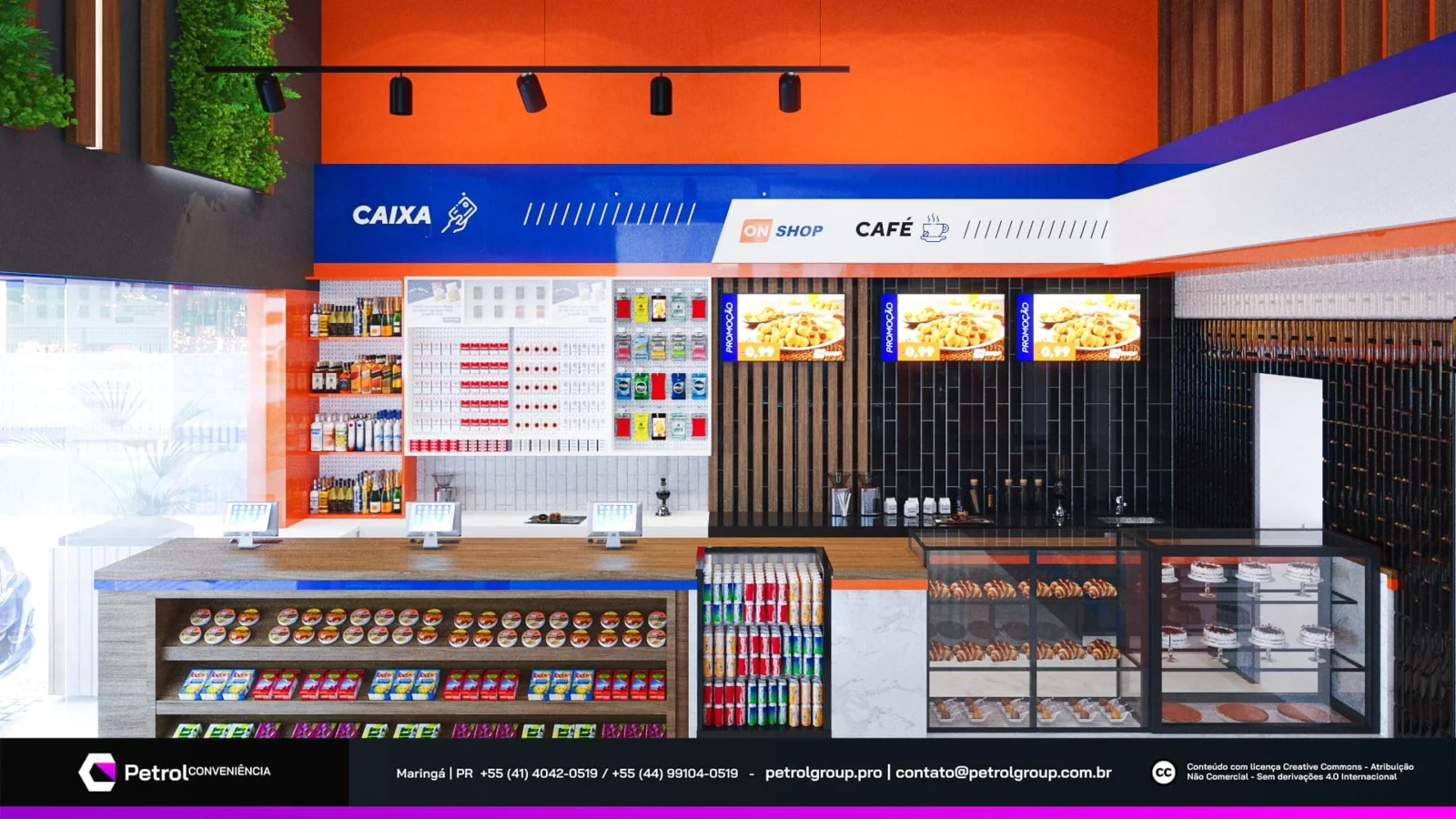
- Register near the entrance with a view of the forecourt. Candy, gum and mints sit on the counter; tobacco sits behind it, where federal rules already put it.
- A separate coffee and food counter, visible from the door, so the morning crowd sees it before reaching the register.
- Beer in its own block of cooler doors, in sight of the cashier, which makes carding easier.
- Endcaps for seasonal and promotional items, with the cookout bundle next to the ice merchandiser.
- Accessible aisles and counters. Under the 2010 ADA Standards, self-service shelves must be on an accessible route but do not have to meet reach-range limits; walking surfaces need a 36-inch minimum clear width; check-out counters may be no higher than 38 inches; and a sales counter needs a section at least 36 inches long and no more than 36 inches high (U.S. Access Board, §§225.2.2, 403.5.1, 904.3.2 and 904.4.1). Our ADA guide for gas stations covers the rest.
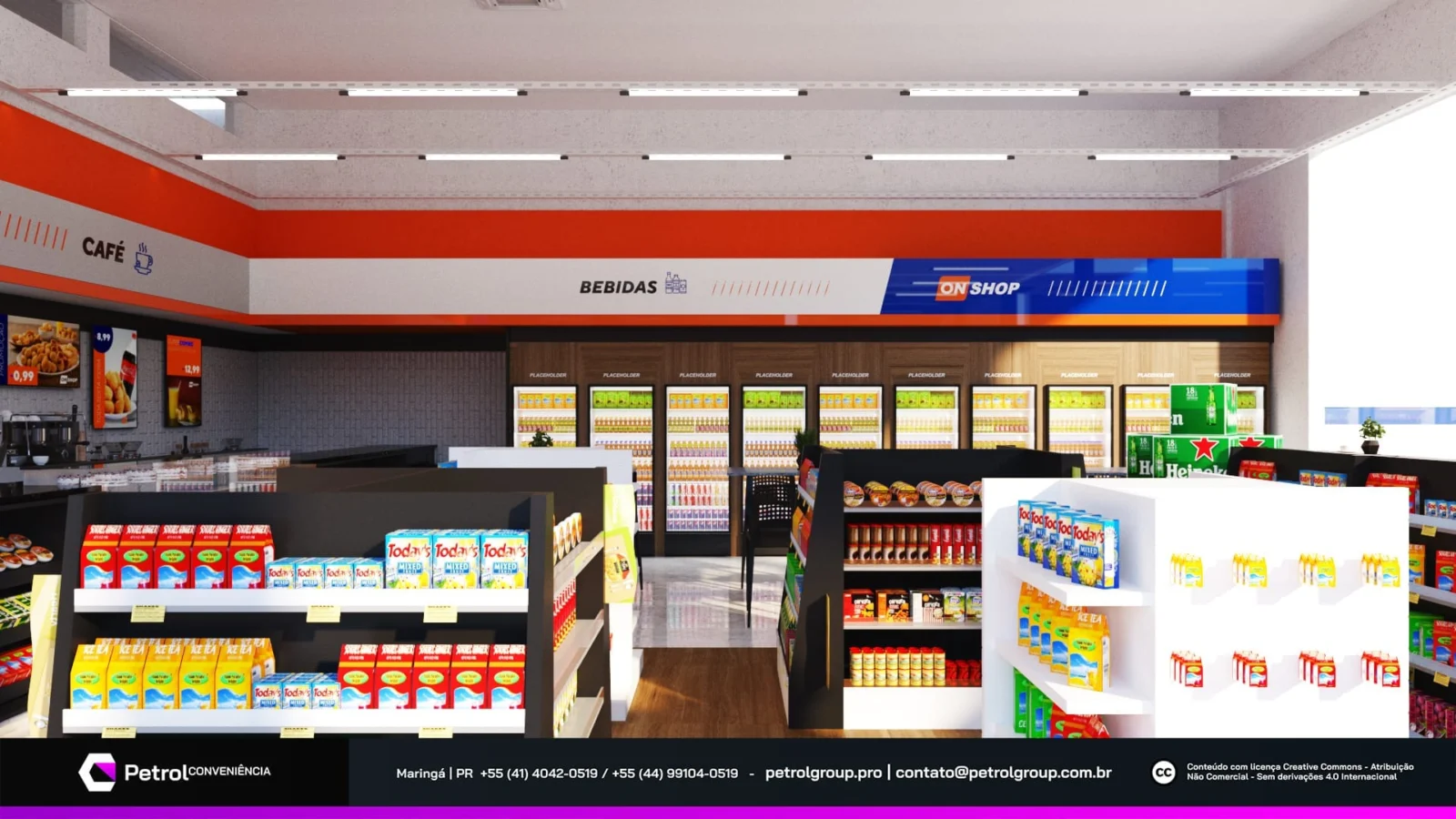
Inside each cooler and gondola, follow buying behavior: water and soda, which people grab without thinking, in the doors closest to the path; the category leader at eye level; multipacks and large formats on the bottom shelf. Even without a legal requirement, the ADA reach range of 15 to 48 inches above the floor (§308.2.1) is a good zone for the items that sell most. Put this on a planogram, the map of where each product goes, so staff can restock and you can measure sales per foot.
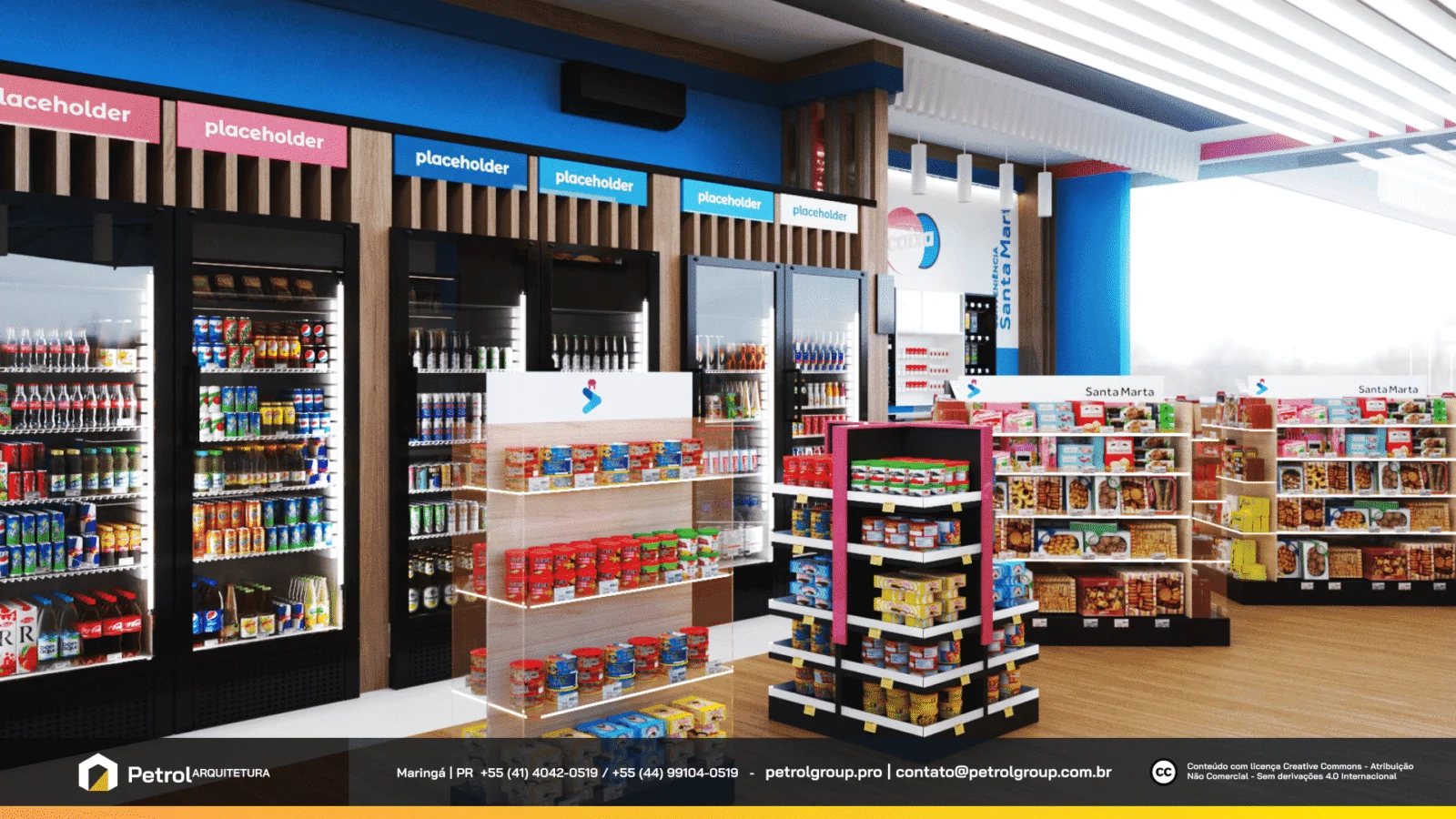
At the Santa Marta convenience store in Itapira, Brazil, the interior project repositioned coolers and displays for easier access, used LED strips for even lighting and laid out the floor for people with reduced mobility. Lighting changes how products look as much as their position does; see our convenience store lighting service. Before ordering coolers, an electrical and plumbing plan makes sure every unit has its outlet and circuit where the floor plan puts it.
Highway vs. urban: adjusting the mix to your site
The same category list works for both. What changes is the weight of each category, the peak hours and a few rules.
| Factor | Highway or interstate site | Urban or neighborhood site |
|---|---|---|
| Who buys | Truck drivers, travelers, families on road trips | Residents, commuters, the late-night crowd |
| Length of stop | Longer, tied to driver breaks | Short, in and out |
| Categories that grow | Hot food, coffee, large water, travel health and beauty, phone chargers, automotive, diesel exhaust fluid near the diesel lanes | Grocery fill-ins, ice and charcoal, beer, morning coffee and lunch |
| Support space | Seating, large restrooms, truck parking if land allows | Quick coffee bar, few seats |
| SNAP | Rarely decisive | Often worth the stocking effort |
Highway and interstate sites
Federal hours-of-service rules shape when truck drivers stop. A property-carrying driver must take 10 consecutive hours off before driving, may drive up to 11 hours within a 14-hour window, and must take a 30-minute break after 8 hours of driving (49 CFR 395.3). Those breaks are your chance to sell a real meal, coffee, cold water, hygiene items and cab supplies. The On Shop store on the BR-277 highway in São José dos Pinhais, Brazil, was designed with clear signs for the register, hot snacks and drinks, and with fixtures and signage meant to be repeated in new units of a chain that runs from Curitiba to Santa Catarina.
Urban and neighborhood sites
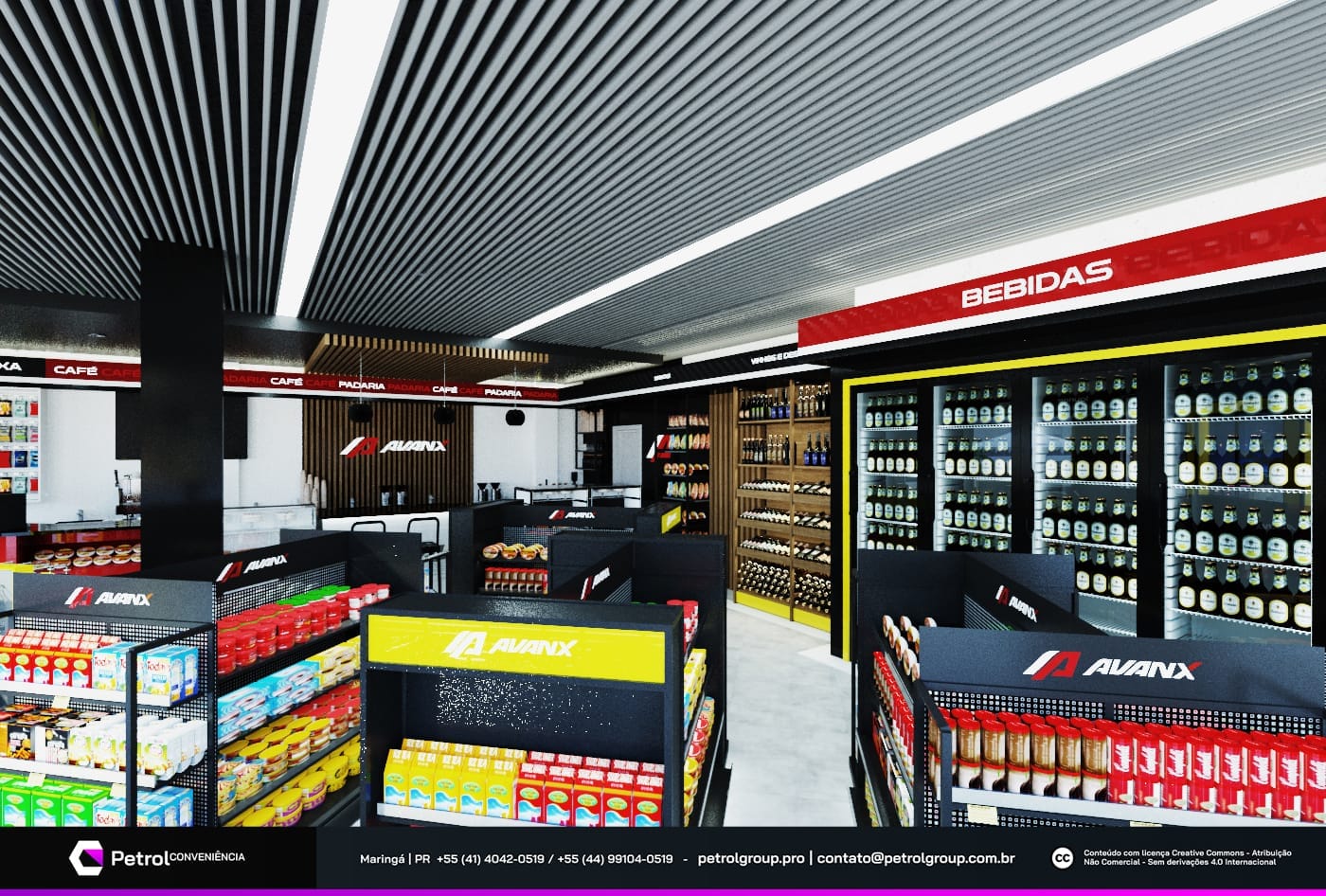
In a neighborhood, the store competes with the grocery store and the dollar store: it needs the milk, bread, ice and cold beer people ran out of, late at night too. Downtown or near offices, morning coffee and a fast lunch drive sales. At the Avanx convenience store, Três Poderes unit, Bahia, Brazil, located in the city’s civic center, daytime customers are professionals such as judges, dentists and lawyers, and nighttime customers are younger. The design answered with a quick coffee area that does not invite long stays, an outdoor lounge for the evening and an ATM next to the restrooms.
Dayparts to test in your POS
Pull hourly sales and see what leads in each daypart. Treat the list below as hypotheses your register should confirm or reject:
- Morning: coffee, breakfast sandwiches, water.
- Lunch: hot food, fountain drinks, snacks.
- Evening: beer, ice, snacks, tobacco.
- Overnight: energy drinks, coffee, tobacco, snacks.
If overnight hours do not cover labor, the problem may be the night mix rather than the hours.
How to build or reset your mix in 7 steps
- Define the site: highway or town, residential or downtown, day and night customers, competitors within a short drive.
- Give each category a job (traffic, margin or draw), using the table in this guide as a starting point.
- Sort out licenses before inventory: health permit for food, state beer and wine license, tobacco retail license where your state requires one, SNAP application if you want it.
- Allocate space by expected sales: cooler doors and gondola feet in proportion to what each category sells, not to the slotting money a vendor offers.
- Draw the planogram with shelf tags and price labels for every item.
- Pick a few reliable suppliers: fast replenishment prevents stockouts on your top items.
- Review monthly: ABC ranking, out-of-stocks, expiration dates and sales per foot. Slow items go; seasonal items come in and out on schedule.
The mistakes that cost the most are predictable: too many SKUs that never sell, a mix copied from another store, the best-selling category hidden in a corner and no sales review. When the problem is the whole store, a convenience store project solves layout, fixtures and lighting at once, built around the mix. Start with the convenience store floor plan.
Frequently asked questions
What products sell the most in a convenience store?
In 2025, foodservice led in-store sales at 28.5%, followed by packaged beverages at 18.7%, according to NACS. Cigarettes were 18.8% of inside sales in 2024 and still drive traffic. Your own ABC ranking tells you which items can never run out.
Do I need a license to sell beer at a gas station?
Yes. Retail beer and wine sales require a state license, usually an off-premise permit, and many cities and counties add hours or zoning limits. Federal law sets the practical purchase age at 21 through highway funding rules (23 U.S.C. §158).
Can a convenience store sell vapes?
Only products FDA has authorized. FDA says authorized e-cigarettes are the only ones that may currently be sold lawfully, a pending application is no safe harbor, and penalties can reach $21,903 per violation. Sales are 21+ with ID checks for anyone under 30.
Can I put cigarettes on a self-service display?
Not in a store open to people under 21. Federal rules allow self-service displays and vending machines only in facilities where no one under 21 is present or allowed in at any time (21 CFR 1140.16). Everywhere else, cigarettes are sold face to face from behind the counter.
What does a store need to accept SNAP?
Under Criterion A, at least 7 varieties in each of 4 staple food categories, 3 units of each variety and perishables in 3 categories, offered continuously. Under Criterion B, more than 50% of gross retail sales must come from staple foods (7 CFR 278.1).
How many products should a small convenience store carry?
There is no legal minimum outside SNAP. NACS uses 500 SKUs as the reference point for a convenience store. In a small store, start with the traffic categories and cut every month what neither turns nor earns margin.
What is the profit margin on convenience store products?
It varies widely by category. Cigarettes averaged a 13.76% margin in 2024 and other tobacco products 29.50%, while foodservice produced 38.9% of in-store gross profit from 28.5% of sales in 2025 (NACS). Calculate yours per item: (price − cost) ÷ price.
Petrol Group has worked only with gas stations for 29 years, with more than 983 projects in 16 countries. In a convenience store design project, we lay out gondolas, coolers, the coffee counter, lighting and power points around the mix your site needs; see more work in our portfolio. If the question is the business case for a remodel, our consulting team runs the numbers with your POS data. To talk about your store, contact our team.