


Car Wash at Gas Stations: How to Increase Revenue and Asset Value
A car wash at a gas station is a strategic service that not only increases revenue, average ticket size, and customer dwell time, but — when properly planned — also generates recurring income, expands cross‑selling opportunities, and significantly enhances the station’s value as a commercial asset, even in scenarios of tight fuel margins.
Car wash services have evolved from a complementary add‑on into a core component of the modern gas station business model. In a context where fuel margins are increasingly compressed, ancillary services such as car washing play a critical role in improving profitability, diluting fixed costs, and positioning the station as a complete and competitive enterprise.
Well‑designed projects demonstrate that stations with integrated car wash operations successfully extend customer dwell time, generate recurring ancillary revenue, and elevate overall value perception. Moreover, car washes create strong cross‑sell opportunities with convenience stores, oil change services, and quick automotive services, forming a complete service ecosystem that drives customer loyalty and maximizes revenue per visit.
This technical guide is based on real projects developed by Petrol Group, integrating operational analysis, infrastructure sizing, and economic feasibility assessment.
👉 https://petrolgroup.pro/
Technical Context of Car Wash Operations at Gas Stations
An efficient car wash goes far beyond the selection of washing equipment. Performance is the result of seamless integration between layout, machinery, operational flow, licensing, water consumption management, and, above all, commercial positioning.
Key technical factors that directly impact performance include:
- – Type of wash: automatic, semi‑automatic, or manual, defining productivity and service profile
- – Operational capacity: vehicles served per hour, essential to avoid queues and maximize revenue
- – Entry and exit flow: integration with forecourt circulation for safe and efficient operation
- – Water and energy consumption: direct impact on operating costs and sustainability
- – Water treatment and reuse: environmental compliance that reduces costs and reinforces ESG positioning
- – Customer experience: speed, comfort, and perceived quality, which drive repeat usage
Without a structured technical project, a car wash can easily become an operational bottleneck, causing queues, resource waste, and low financial return. Proper planning and integration are essential to transform the service into a true competitive advantage.
Types of Car Wash Systems for Gas Stations
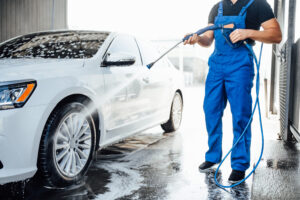
Choosing the right car wash model depends on station profile, vehicle flow, available area, and commercial strategy. Each model presents distinct advantages and limitations:
1. Automatic Car Wash
Ideal for high‑traffic stations focused on scale.
- – High throughput and productivity
- – Standardized wash quality
- – Lower labor dependency
- – Higher initial investment
2. Semi‑Automatic Car Wash
Balanced solution between cost and control.
- – Combines equipment and operator
- – Consistent wash quality
- – Operational flexibility
- – Moderate investment level
3. Manual Car Wash
Common in urban or neighborhood stations.
- – Lower initial investment
- – Higher labor requirements
- – Variable quality depending on staff
- – Lower throughput, suitable for limited demand
The optimal choice aligns commercial strategy, operational capacity, and customer experience to ensure efficiency, profitability, and sustainability.
Steps to Implement a Car Wash at a Gas Station
Successful car wash implementation requires integrated technical, operational, and commercial planning:
1. Technical and Commercial Feasibility Analysis
- – Evaluation of vehicle flow, available area, and local competition
- – Projection of average ticket and ROI
- – Identification of cross‑selling opportunities
2. Definition of Operational Model
- – Selection of car wash type
- – Definition of service capacity per hour
- – Integration with convenience store, oil change, and loyalty programs
3. Layout and Infrastructure Design
- – Entry, exit, and circulation planning
- – Drainage, flooring, and technical area sizing
- – Operational safety for customers and staff
4. Equipment Selection
- – Washing, drying, and chemical dosing systems
- – Automation level to maximize productivity
- – Cost‑benefit, durability, and maintenance analysis
5. Environmental Licensing
- – Compliance with regulations, including oil‑water separators
- – Implementation of water reuse systems
- – Sustainable and legally compliant operation
6. Commercial Integration
- – Bundles and combos with fuel and convenience store
- – Loyalty programs to increase repeat usage
- – Strategies to boost average ticket and profitability
Following these steps ensures a profitable, efficient, and fully integrated car wash operation.
Car Wash Equipment: What to Consider
Equipment selection directly impacts operational efficiency and profitability. Properly sized machines ensure productivity, service quality, and customer satisfaction, while poor choices lead to high costs and revenue loss.
Key technical criteria:
- – Vehicles washed per hour
- – Water and energy consumption
- – Level of automation
- – Ease of maintenance
- – Availability of technical support
- – Compatibility with water reuse systems
Correct equipment sizing guarantees safe operation, high productivity, and superior customer experience.
Technical Table: Car Wash Impact on Station Performance
| Element | Direct Business Impact |
|---|---|
| Automatic car wash | Higher recurring revenue |
| Integration with convenience store | Increased average ticket |
| Water reuse systems | Lower operating costs |
| Well‑planned flow | Higher service capacity |
| Ancillary services | Increased asset valuation |
Common Mistakes When Implementing a Car Wash
- – Lack of feasibility study
- – Undersized area and infrastructure
- – Equipment chosen solely by price
- – Ignoring water consumption and environmental requirements
- – No commercial integration or cross‑selling strategy
- – Insufficient operational training
These mistakes reduce margins, increase costs, and limit growth. A structured project avoids these pitfalls and ensures sustainable profitability.
Frequently Asked Questions
Does a car wash really increase gas station revenue?
Yes. Beyond direct revenue, it extends dwell time and creates cross‑selling opportunities, strengthening the station’s service ecosystem.
Is a car wash viable for small stations?
Yes, when the model matches available space, vehicle flow, and investment capacity.
Does a car wash consume too much water?
With proper reuse systems, consumption is controlled, sustainable, and economically viable.
Is environmental licensing mandatory?
Yes. Compliance with water treatment and disposal regulations is essential for legal and sustainable operation.
Specialized Car Wash Consulting for Gas Stations
Implementing a car wash goes far beyond purchasing equipment. It requires integration of engineering, licensing, operations, and, above all, commercial strategy. Without this, the service becomes a cost rather than a strategic asset.
Petrol Group delivers complete car wash solutions for gas stations — from feasibility studies to execution and commercial integration — always focused on performance, profitability, and asset valuation.
🚀 Want to know if a car wash is technically and economically viable for your station?
Request a Technical Car Wash Diagnosis and discover how to:
- – Increase station revenue
- – Diversify income through ancillary services
- – Enhance asset value with predictability and safety
With Petrol Group, everything your gas station needs is in one place.