




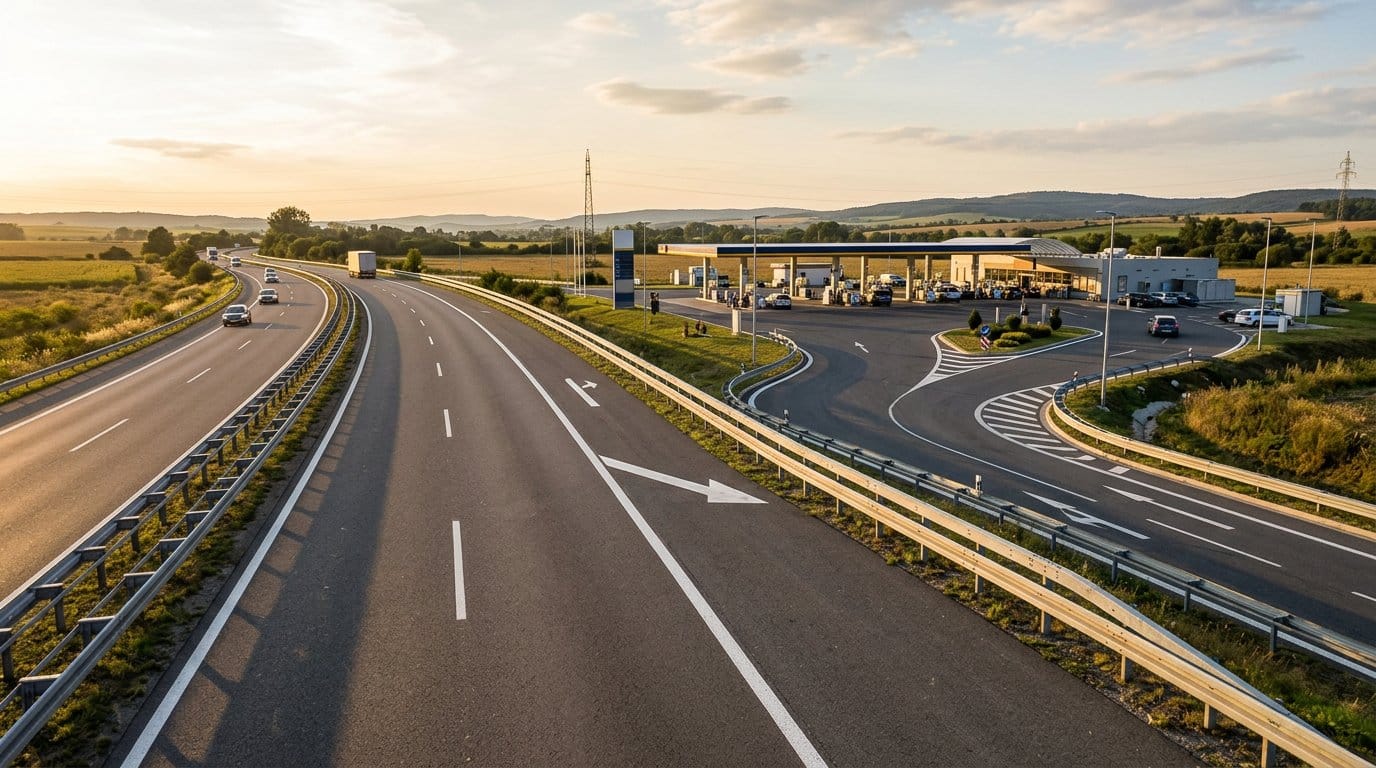
Building a gas station on a highway is one of the most regulated projects in the industry. Besides zoning, the building and fire permits, the state tank program and the environmental permits, the physical connection to the road needs its own approval from the agency that owns it — on most highways, the state department of transportation (DOT). Many highway projects are delayed or become unworkable because owners overlook this step, and a connection built without a permit can be closed.
Petrol Group has experience with highway gas station projects. Here is who approves the access, what is required and how long it takes in the United States.
State DOT, Interstate or local road: who approves the access
- State highways: the state DOT issues the driveway or access permit, usually through its district office. In Pennsylvania, for example, you need a Highway Occupancy Permit (HOP) to build or change a driveway on state highway land, requested from the district permit manager through the Electronic Permitting System (PennDOT). In Florida, connections to the State Highway System need a connection permit under Rule Chapter 14-96, F.A.C. (Florida Administrative Code).
- Interstate highways: federal law bars automotive service stations and other commercial establishments for motorists on the Interstate right-of-way, and states cannot add access points without approval from the U.S. Secretary of Transportation (23 U.S.C. 111). That is why stations serving Interstate traffic sit on the crossroads near the interchanges, where access is permitted by the agency that owns that road.
- County and city roads: the access is permitted by the local agency, usually the public works or engineering department. The process is similar, but standards and fees vary from place to place.
Before closing on the land, confirm the status of the road in front of it: whether it is a state, county or city road, whether it is access-controlled and which office is responsible for it. The DOT district office and the local planning department can tell you.
Right-of-way and setbacks
The right-of-way is the land that belongs to the road agency along the highway. It includes the travel lanes, the shoulders and an additional strip on each side. Any work inside it, such as a driveway, curb cut, drainage or utility connection, needs the agency’s permit. Its width varies from road to road and must be confirmed with the agency and on the survey.
Beyond it there are the building setbacks: in the U.S., the distance between the right-of-way line and the canopy, the store or the tanks is set by local zoning, not by a single national rule. These numbers go into the site study of the station: they define where the canopy, the store and the tanks can go.
Step by step: the state DOT access permit
- Pre-application meeting with the DOT district office (or the local agency). Florida’s rule, for example, provides a voluntary pre-application process.
- Traffic study when the agency requires it. PennDOT, for example, requires a Transportation Impact Study when the site is expected to generate 3,000 or more trips per day, or 150 or more trips entering or exiting in any one hour, or when it expects a significant impact on safety or traffic flow; otherwise it may ask for a smaller assessment of the site access (PennDOT policy, 2025).
- Access plans with the station’s entrance and exit, turn lanes, drainage, signs and pavement markings, prepared by a licensed civil or traffic engineer.
- Permit issued, followed by construction and inspection under the permit conditions.
This process runs in parallel with zoning, the building permit and the environmental permits for the gas station, and it does not replace any of them.
Technical requirements for the access and the highway gas station
Highway access
- Deceleration and acceleration lanes: sized by the traffic engineer in the access design, under the access management standards of the state. The FHWA lists dedicated left- and right-turn lanes among the core access management techniques (FHWA).
- Turning radius at the entrance: defined in the design by the path of the largest vehicle that will use the access, such as tractor-trailers and buses.
- Spacing between accesses: the entrance must keep the distance to neighboring driveways, intersections and signals required by the agency. FHWA notes that fewer driveways, spaced further apart, allow more orderly merging of traffic.
- Divided highways: where a median prevents left turns, the driveway is limited to right turns in and out, and left turns depend on median openings the agency approves; PennDOT lists an existing median among the conditions that restrict driveway movements.
- Signs and pavement markings under the Manual on Uniform Traffic Control Devices (MUTCD), the national standard for traffic control devices on roads open to public travel.
- Access lighting as required by the road agency and local codes.
Station and canopy
The canopy needs clearance for trucks and buses. There is no federal vehicle height limit: each state sets its own (FHWA), so the clearance is defined in the design for the tallest vehicles the station will serve. Other layout differences, such as truck maneuvering areas, truck parking and a driver rest area, are covered in our comparison highway vs urban gas station.
How long approval takes
There is no single timeline: review time varies from state to state and from one DOT district to another, and it depends on the application being complete. As an example, PennDOT says it has 60 days to review each Highway Occupancy Permit application and aims to finish within 30 days (PennDOT). Check with the agency responsible for the road before closing on the land, and put that time in the construction schedule.
That is why the access design should be delivered together with the gas station architecture design, not afterwards. When both start together, the access geometry, the position of the fueling islands and the truck flow on the forecourt come out compatible. See an example from Brazil in our federal highway gas station case.
What Petrol Group handles in the design
- Site study that places the canopy, store, tanks and islands outside the right-of-way and within the zoning setbacks.
- Forecourt layout compatible with the access geometry and with the truck and car flow.
- 3D renderings, design specifications and the architecture set for coordination with the civil and traffic engineers.
Petrol Group works remotely. A locally licensed civil or traffic engineer signs the access design and files it with the DOT or the local agency, and the architect or engineer of record files the building permit. Petrol Group is a Brazilian design firm founded in 1997, with 983+ projects in 16 countries, including highway stations. Talk to our team before closing on the land, and see gas station design in the USA.
FAQ
Can an existing farm or field entrance be converted for the gas station?
In general, not without a new approval. A change of use usually needs a new or modified permit. In Florida, for example, if the added traffic from a redevelopment is a significant change, a new application is required, and if a business use has been discontinued for one year or more, any new proposed use counts as a significant change (Rule 14-96). Check the rule of your state with the DOT.
Can a station on the other side of the highway use an existing median opening or U-turn?
Median openings and U-turns are part of the highway and are controlled by the road agency. Their use by the station is evaluated case by case, considering the capacity of the opening and the distance to it.
Can a gas station be built at an Interstate rest area?
No. 23 U.S.C. 111 bars automotive service stations on the Interstate right-of-way, and FHWA guidance says the sale of petroleum products at rest areas is prohibited (FHWA).
Does a highway gas station need a different environmental permit?
No. The station follows the same EPA tank rules (40 CFR Part 280) and the same state programs as an urban station. What changes is the access permit from the road agency, which is additional.