





A compliant gas station runs on five written standard operating procedures (SOPs): fuel delivery, dispensing, service bay and used oil, spill response and fire. In the U.S., the rules behind them come from EPA’s underground storage tank (UST) regulations in 40 CFR 280, OSHA’s service station rules in 29 CFR 1910.106(g), OSHA’s fire extinguisher and emergency plan standards, EPA’s SPCC rule when your aboveground oil capacity crosses the threshold, and the fire code your fire marshal adopted (NFPA 30A or IFC Chapter 23). This checklist gives each SOP step by step, with the rule behind it and a daily, monthly and annual calendar.
Every citation below was checked against the current text on eCFR, OSHA, EPA and NFPA in November 2026. States can be stricter, so treat this as the federal floor and confirm local amendments with your state UST program and fire marshal.
Which rules apply to a gas station
| Rule | What it covers at the station | Key requirement |
|---|---|---|
| EPA UST rule, 40 CFR 280 | Tanks, piping, spill buckets, sumps, deliveries, operator training | Spill and overfill control (280.30), 30-day walkthroughs (280.36), Class A/B/C operators (Subpart J) |
| EPA used oil rule, 40 CFR 279 | Oil change bays | “Used Oil” labels, sound containers, release cleanup (279.22) |
| EPA SPCC rule, 40 CFR 112 | Aboveground oil storage and some buried tanks | Written SPCC Plan above 1,320 gal aboveground or 42,000 gal completely buried (112.1) |
| OSHA 29 CFR 1910.106(g) | Service stations | No smoking, engines off, spill control, one 6-B:C extinguisher within 75 ft of each pump |
| OSHA 29 CFR 1910.157 and 1910.38 | Extinguishers and emergency action plans | Monthly checks, annual maintenance, training, written plan |
| OSHA 29 CFR 1910.132(d) | Workplace hazard assessment | Written certification of the PPE hazard assessment |
| NFPA 30A or IFC Chapter 23 | Dispensing, emergency shutoff, attendants, repair garages | Edition and amendments set by your state or city |
Most states run the UST program themselves under EPA approval; EPA keeps the list of approved state UST programs. Where a state program is approved, its rules are the ones the inspector cites. For the full code map by system, see our gas station codes and standards guide.
SOP 1: fuel delivery
Deliveries are where most overfills start. EPA puts the duty squarely on the owner and operator: the volume available in the tank must be greater than the volume to be transferred, checked before the transfer, and the transfer must be monitored constantly (40 CFR 280.30(a)). The rule’s note says the transfer procedures in NFPA 385 or API RP 1007 may be used to comply. A delivery SOP built on that:
- Before the truck arrives. Read the automatic tank gauge and confirm ullage for every product on the bill of lading. Write it down.
- Spill bucket check. The 30-day walkthrough includes the spill prevention equipment: check for damage, remove liquid or debris, clear obstructions in the fill pipe and confirm the fill cap is secure. Stations with deliveries less often than every 30 days may check before each delivery instead (280.36).
- Control the area. No smoking or open flames where flammable liquids are received or dispensed (1910.106(g)(8)). Keep customer vehicles clear of the truck and the fill ports.
- Right product, right tank. Match each compartment to the fill port. A mismatch caught here costs nothing; one caught after the drop means pumping out a tank.
- Stay with the drop. Someone from the station watches the whole transfer, as 280.30(a) requires “constantly”. The driver handles the truck’s emergency valves.
- Close out. Re-read the gauge, record the delivery and reconcile it against the invoice. Replace caps and close spill buckets.
If something goes wrong: a petroleum spill or overfill that releases more than 25 gallons to the environment, or that causes a sheen on nearby surface water, must be contained, cleaned up and reported to the implementing agency within 24 hours. Smaller spills must still be cleaned up at once, and if cleanup takes more than 24 hours the agency must be notified (40 CFR 280.53).

The SAVI project shows a layout many owners want: c-store, patio, car wash, oil change and auto electric shop on one lot of about 37,700 sq ft (3,500 m²), with roughly 11,450 sq ft (1,064 m²) built. With that many people near the forecourt, where the tanker parks and how it leaves is a safety decision made on the site plan, long before anyone writes an SOP.
SOP 2: dispensing
This is the procedure your attendants and cashiers repeat all day, so keep it to one page. The federal points:
- no smoking or open flames in fueling and receiving areas, with conspicuous, legible no-smoking signs “within sight of the customer being served” (1910.106(g)(8));
- the motors of all equipment being fueled are shut off during fueling (same paragraph);
- the forecourt is graded or built so spilled fuel does not flow into the building, and fuel never goes into sewers (1910.106(g)(7));
- an emergency disconnect switch that stops fuel to the dispensers, “distinctly labeled: EMERGENCY FUEL SHUTOFF”, at an approved location (IFC 2303.2, as adopted in Virginia’s Statewide Fire Prevention Code; your state’s wording may differ);
- every employee who meets the Class C operator definition, usually whoever controls or monitors dispensing, designated and trained to respond to spills, releases and alarms (40 CFR 280.241 and 280.242, Subpart J).
Your SOP should say who presses the emergency shutoff, where the spill kit sits at each island and what the cashier tells a customer who tops off and overflows. Attended and unattended self-service rules come from NFPA 30A or IFC Chapter 23 as your jurisdiction adopted them. The current edition of NFPA 30A is 2027, but many fire marshals still enforce an older one, so ask which edition applies before training staff on it.

SOP 3: oil change bay and used oil
In the Copagra project, the layout organizes access and circulation between fueling, car wash, oil change and the c-store. Each of those services needs its own SOP. For the oil change bay, EPA’s used oil generator rule (40 CFR 279.22) sets the baseline:
- store used oil only in tanks or containers that are in good condition and not leaking;
- label containers, aboveground tanks and the fill pipes of used oil USTs with the words “Used Oil”;
- on a release: stop it, contain it, clean it up and repair or replace the leaking container before putting it back in service;
- used oil generators are also subject to SPCC, and used oil kept in underground tanks falls under the UST rule.
OSHA adds one line that still catches stations: crankcase drainings and flammable liquids must not be dumped into sewers and must be stored in tanks or drums outside any building until removed from the premises (1910.106(g)(7)). Drums of used oil and new lubricants also count toward your SPCC capacity, which brings us to the rule most station owners overlook.
Does your station need an SPCC Plan?
EPA’s Spill Prevention, Control and Countermeasure rule applies when a facility stores more than 1,320 gallons of oil aboveground, counting only containers of 55 gallons or more, or more than 42,000 gallons completely buried (40 CFR 112.1). Buried tanks that meet all the technical requirements of part 280 or an approved state UST program are excluded from the buried total.
| Situation | SPCC status |
|---|---|
| Fuel only in compliant USTs; a few drums of lubricant under 1,320 gal total | Usually not subject |
| Aboveground fuel tank, generator tank, used oil tank and drums adding up to more than 1,320 gal | Subject: written plan required |
| Aboveground capacity of 10,000 gal or less and a clean discharge history | Qualified facility: owner may self-certify (112.3(g) and 112.6) |
| Above the qualified facility limits | Plan reviewed and certified by a licensed Professional Engineer (112.3(d)) |
The clean history test for a Tier II qualified facility is no single discharge over 1,000 gallons and no two discharges over 42 gallons each within any 12-month period in the three years before self-certification. EPA explains the thresholds and plan types on its SPCC overview page.
SOP 4: spills, releases and the emergency action plan
When a release from the UST system is confirmed or found any other way, the owner and operator have 24 hours to report it to the implementing agency, stop further release and identify and mitigate fire, explosion and vapor hazards (40 CFR 280.61). Put those three actions, with phone numbers, on the first page of the spill SOP.
OSHA’s emergency action plan rule (29 CFR 1910.38) applies whenever another OSHA standard requires a plan, which at a gas station usually happens through the fire extinguisher standard. The plan must be written, kept on site and available to employees; an employer with 10 or fewer employees may communicate it orally. It must cover at least:
- how to report a fire or other emergency;
- evacuation procedures and exit route assignments;
- who stays to shut down critical operations, such as the emergency fuel shutoff, before evacuating;
- how to account for all employees after evacuation;
- who performs rescue or medical duties;
- the name or job title of the person to contact about the plan.
The plan is reviewed with each employee when it is created, when the employee is hired or changes duties, and whenever the plan changes (1910.38(f)).
SOP 5: fire
Every service station needs at least one extinguisher rated 6-B:C or better, located so one is within 75 ft of each pump, dispenser, underground fill pipe opening and lubrication or service room (29 CFR 1910.106(g)(9)). Your fire code may ask for more or larger units; the higher number wins.
Under 29 CFR 1910.157, portable extinguishers get a visual inspection every month and a maintenance check every year, with the annual date recorded and kept for one year after the last entry. If employees are expected to use them, they get training on initial assignment and at least annually. The alternative is a written policy of immediate total evacuation, backed by an emergency action plan and a fire prevention plan (1910.157(b)). Pick one and write it into the SOP; mixing both confuses staff in the moment that matters.
The hazard map: what OSHA actually asks for
Many station templates mention a “hazard assessment map”. We found no federal OSHA rule requiring a posted risk map. What OSHA does require is a workplace hazard assessment for PPE and a written certification that names the workplace evaluated, the person certifying and the date (29 CFR 1910.132(d)).
A marked-up site plan is still the easiest way to do that assessment and train new hires. Start from the construction drawings and mark the dispensers, fill ports, vents, oil change bay, car wash and c-store entrances, then note the PPE and the SOP that applies in each zone.
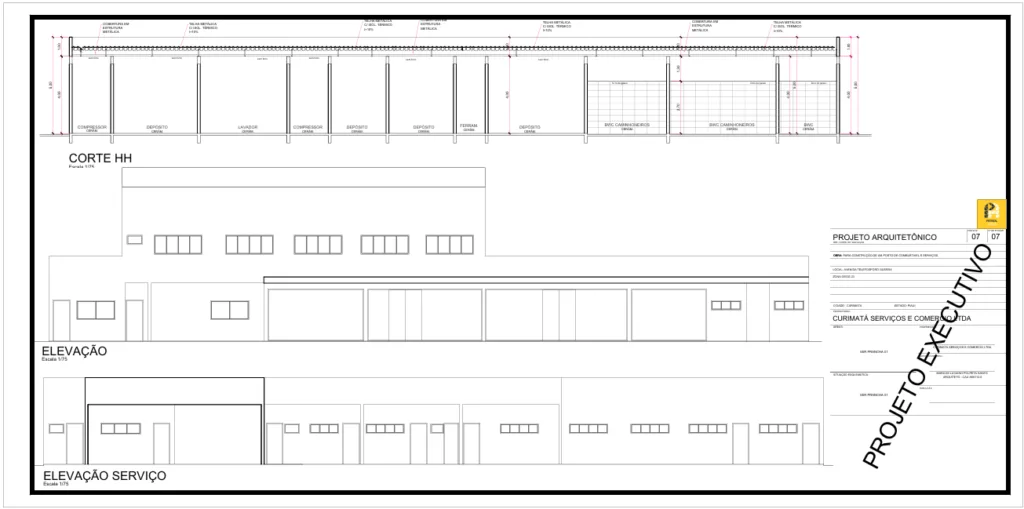
In the Curimatá project, Petrol Group carried the design from the preliminary study to the construction drawings, with attention to how people and vehicles move on site. That is the stage where a tanker route that never crosses the fueling queue gets decided.
Benzene. OSHA’s benzene standard does not apply to retail dispensing of gasoline, except where fuel is dispensed for more than 4 hours per day in an indoor location (29 CFR 1910.1028(a)(2)(i)). Where it applies, the limits are 1 ppm as an 8-hour average and 5 ppm over 15 minutes. Brazil, by contrast, has a full annex on benzene at gas stations, with semiannual blood counts for attendants; it is a useful benchmark for international operators.
Gas station operations calendar
| Frequency | Task | Rule |
|---|---|---|
| Every delivery | Confirm ullage, watch the transfer, record and reconcile | 40 CFR 280.30 |
| Every shift | Staff on duty trained as Class C operators; spill kits stocked; emergency shutoff unobstructed | 40 CFR 280 Subpart J; fire code |
| Every 30 days | Walkthrough: spill buckets, release detection alarms and records | 40 CFR 280.36 |
| Monthly | Visual check of every extinguisher | 29 CFR 1910.157(e) |
| Annually | Extinguisher maintenance; extinguisher training if staff use them | 29 CFR 1910.157(e) and (g) |
| On hire or change of duties | Review the emergency action plan with the employee | 29 CFR 1910.38(f) |
| On the state schedule | Dispenser accuracy tested and sealed by state or local weights and measures, using NIST Handbook 44 tolerances | NIST HB 44, adopted by all 50 states |
| When aboveground storage changes | Recheck the SPCC threshold and update the plan | 40 CFR 112.1 |
Where design makes SOPs easier
An SOP cannot fix a fill port placed where the tanker blocks the exit, or a vent next to the c-store’s fresh air intake. Those are site plan decisions. Petrol Group has worked only on fuel stations for 29 years, with 983+ projects in 16 countries, and our architecture and consulting teams review circulation, delivery routes and service bay placement before construction. Related guides: gas station equipment and lightning protection under NFPA 780. See more projects in our portfolio.
Frequently asked questions
What should a gas station opening checklist include?
Read the tank gauge and check for alarms, confirm the emergency fuel shutoff is clear and labeled, check that each island has a spill kit and an extinguisher within 75 ft, and confirm the staff on shift have Class C operator training. Log anything abnormal before the first sale.
Who is responsible for a spill during a fuel delivery?
Under 40 CFR 280.30, the UST owner and operator must confirm there is room in the tank and monitor the transfer constantly. The carrier follows its own procedures, but the station cannot hand off the duty to watch the drop.
When does a gas station spill have to be reported?
A petroleum spill or overfill over 25 gallons, or one that causes a sheen on nearby surface water, must be reported to the implementing agency within 24 hours. Smaller spills are cleaned up at once, and the agency is notified if cleanup takes longer than 24 hours.
Does a gas station need a written emergency action plan?
If an OSHA standard requires one, yes, and it must be written unless you have 10 or fewer employees, in which case it can be communicated orally. Most stations trigger it through the fire extinguisher standard.
How often must fire extinguishers be inspected at a gas station?
A visual check every month and a maintenance check every year, with the annual date recorded (29 CFR 1910.157(e)). If employees are expected to use them, they also need training at hire and every year.
Do gas stations need an SPCC Plan?
Only if aboveground oil storage exceeds 1,320 gallons, counting containers of 55 gallons or more, or buried storage not covered by the UST rule exceeds 42,000 gallons. Aboveground tanks, used oil tanks and drums are what usually push a station over the line.
Does OSHA’s benzene standard apply to gas station attendants?
Generally no: 29 CFR 1910.1028 exempts retail dispensing of gasoline. The exception is fuel dispensed indoors for more than 4 hours a day, where the 1 ppm limit applies.